I returned to Corsica after 21 years, the same way a grown woman revisits her first love trying to understand what might have been and what she missed back then.
Corsica outside the tourist season is the kind of rough gem you explore at the pace of your own breath. It is a proud mare no one has yet managed to mount, but which seems to have mellowed somewhat in the meantime: it lets herself be groomed and caressed.
Only the mountain is still as unforgiving as ever.
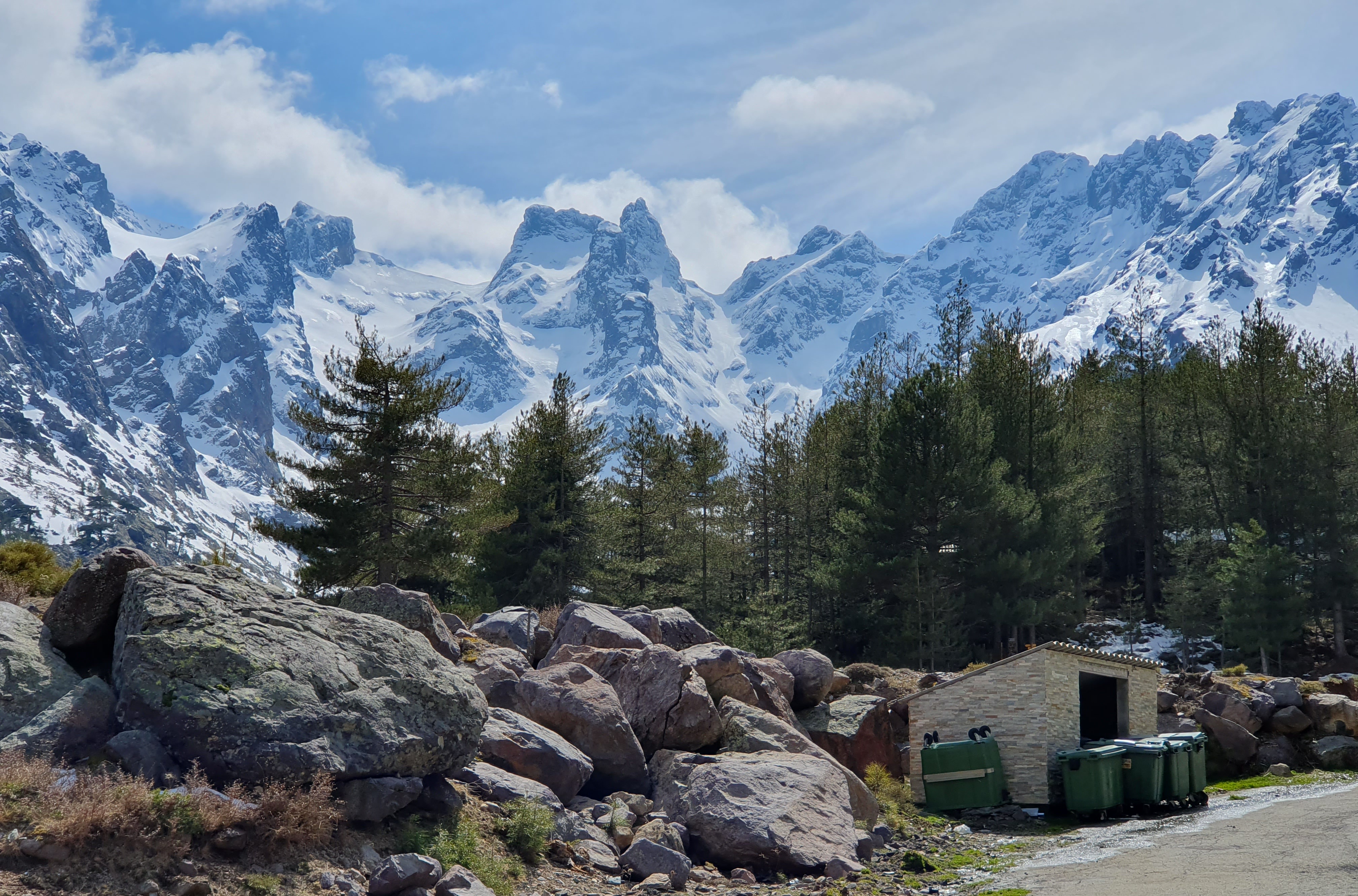
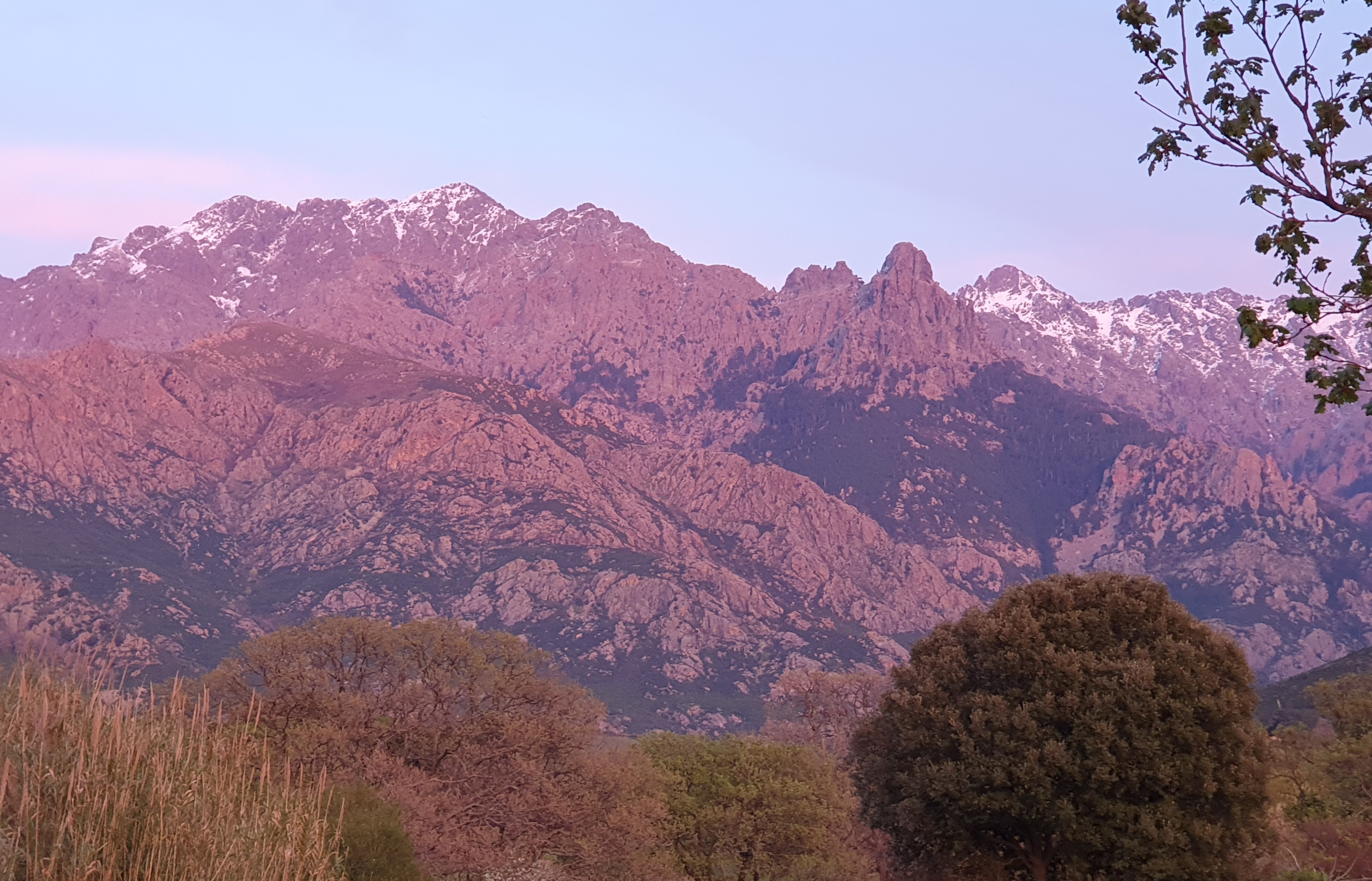
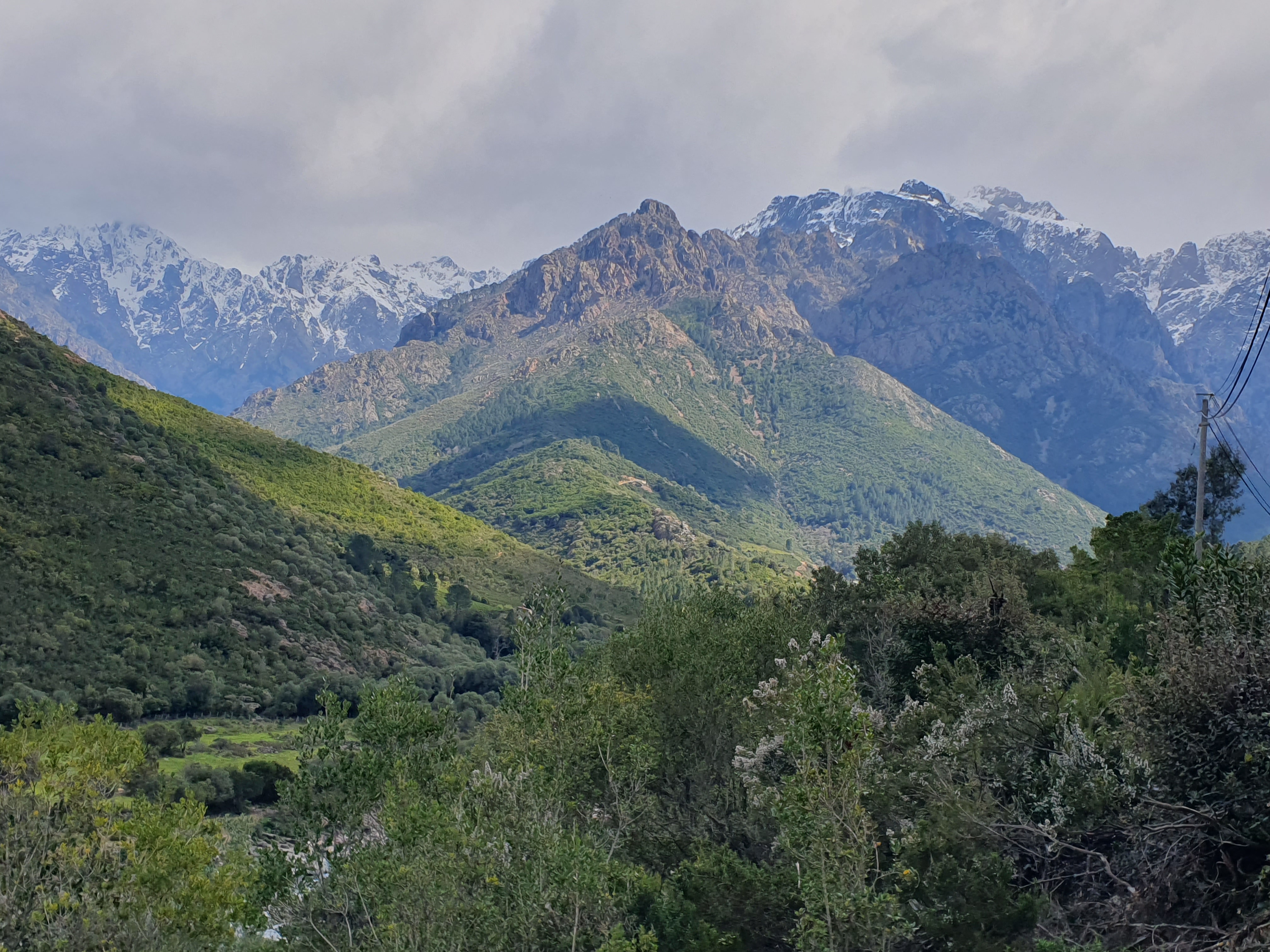
Surrounded by waves in different shades of ultramarine, weighed down by snow and the tangled thickets of the thorny maquis that burns every summer, crisscrossed by patchy, potholed roads, carved (and then smoothed to velvety softness) by torrents, it seems impenetrable. It dominates, it towers over everything, shrouded in a soundless blanket of whitish light. Quiet. COMPLETE silence. Like nowhere else I’ve ever been, except perhaps my native Carpathians many lives ago.
No engines, no cowbells (here the animals roam free, with their calves following closely behind). As you climb, you hear only the wind, the roar of the river, and your own footsteps.
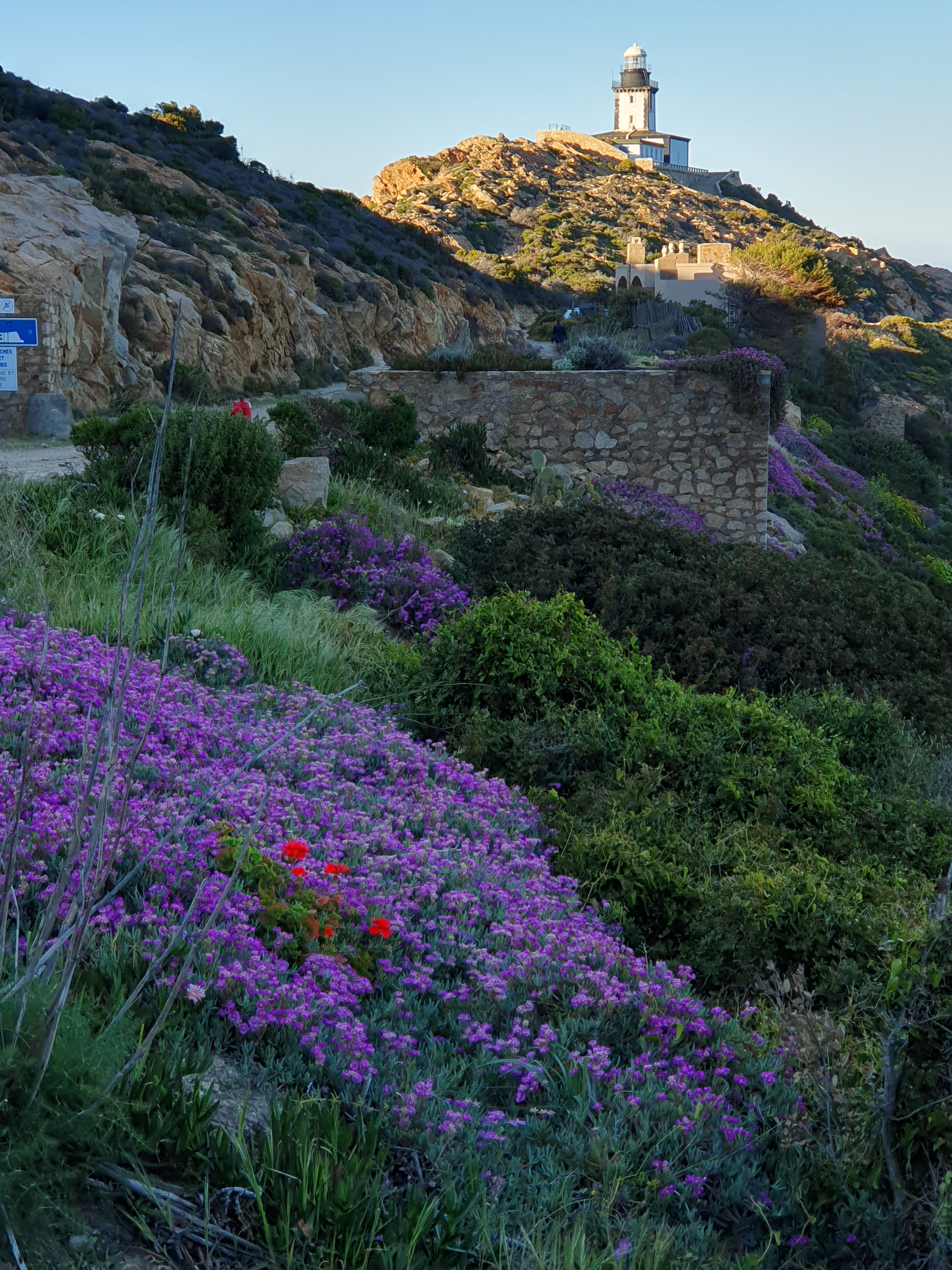
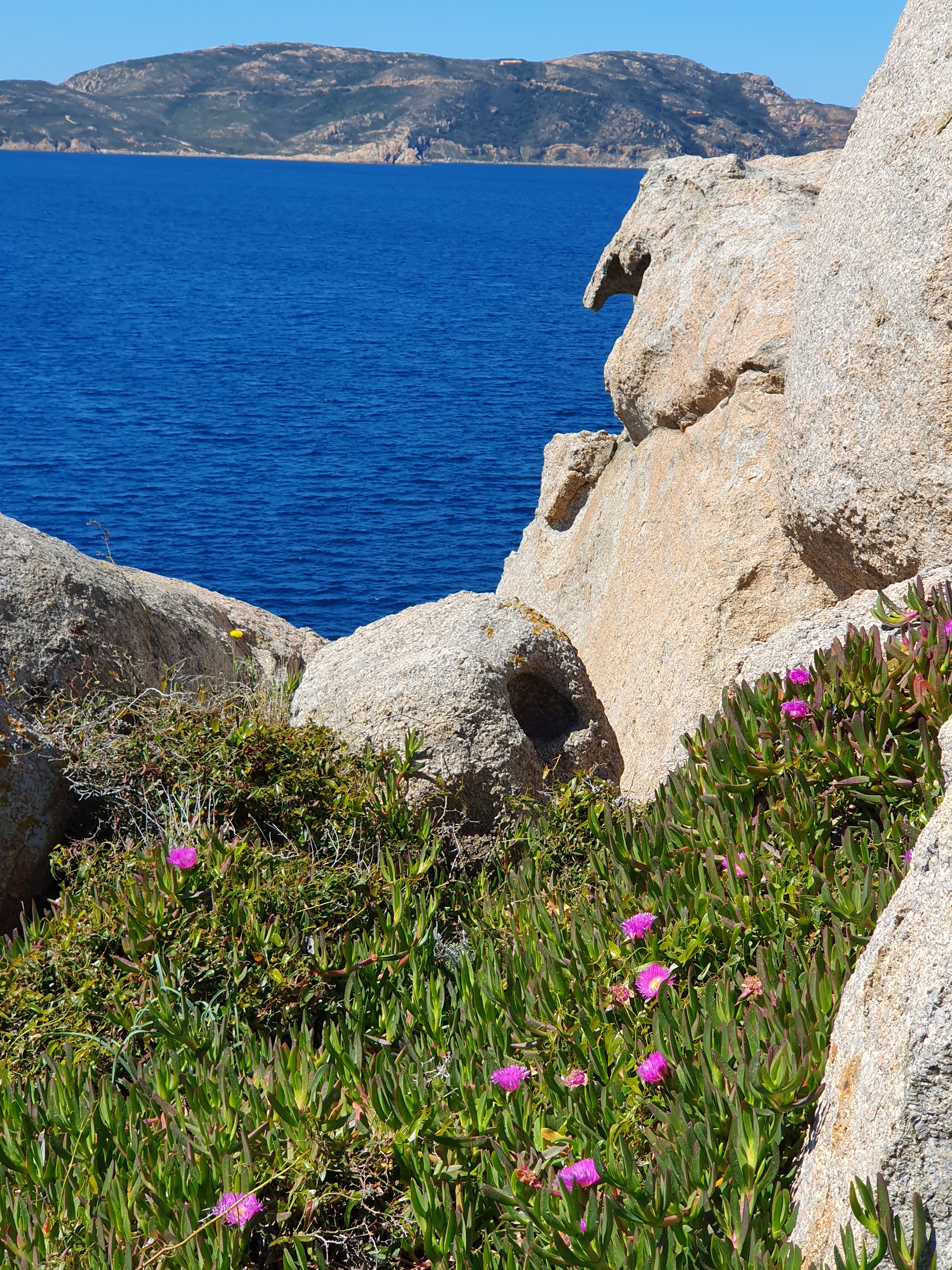
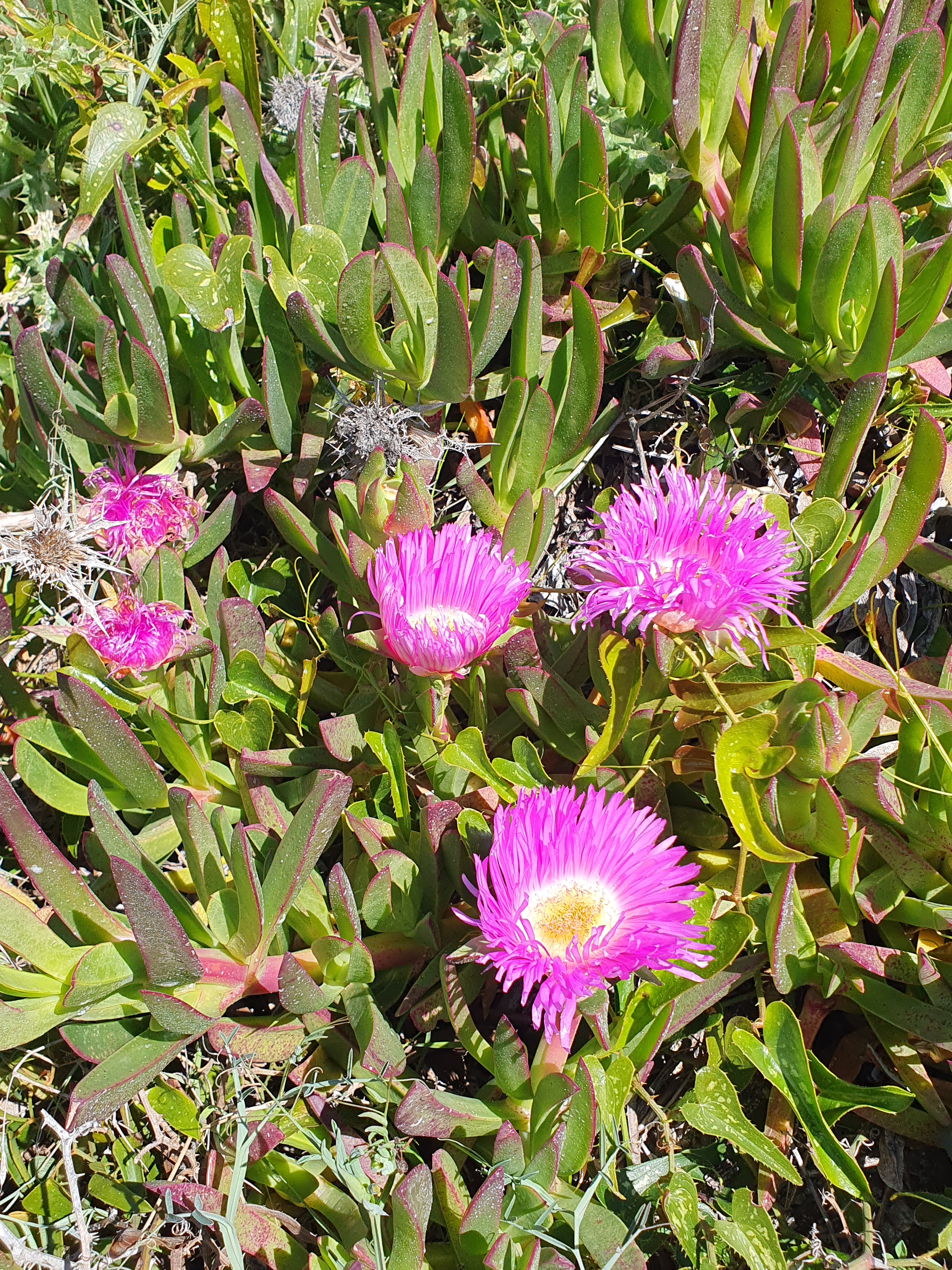
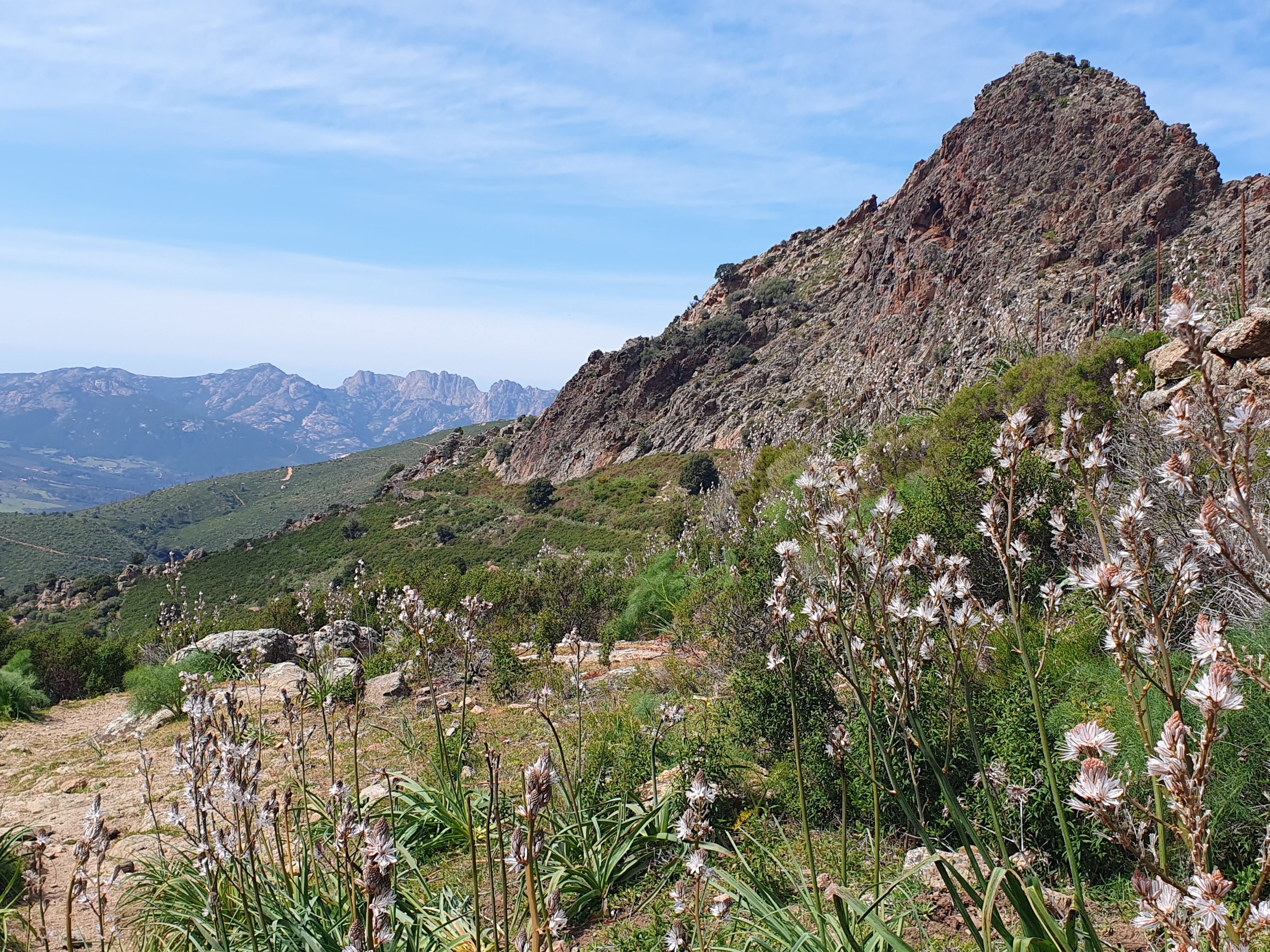
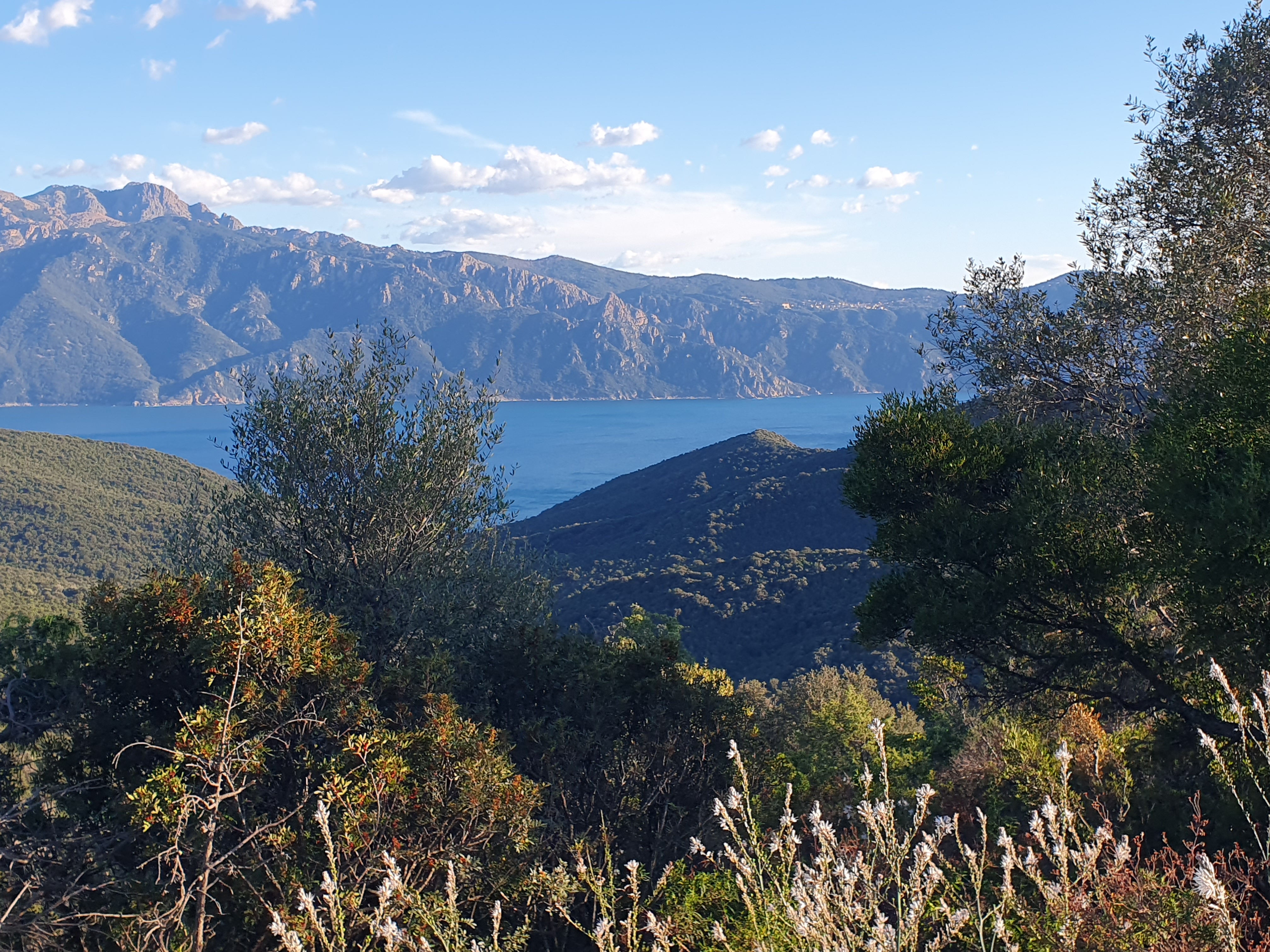
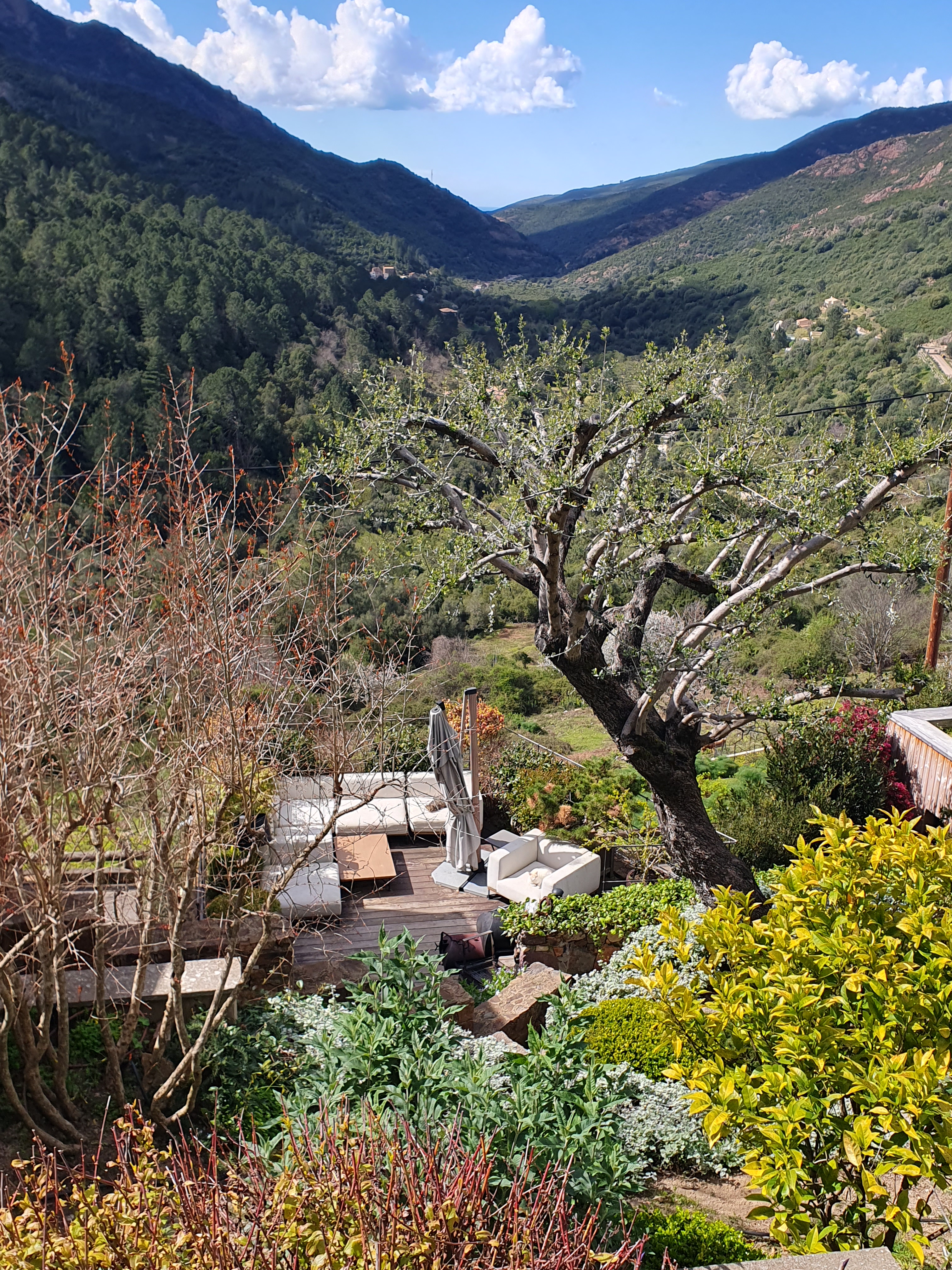
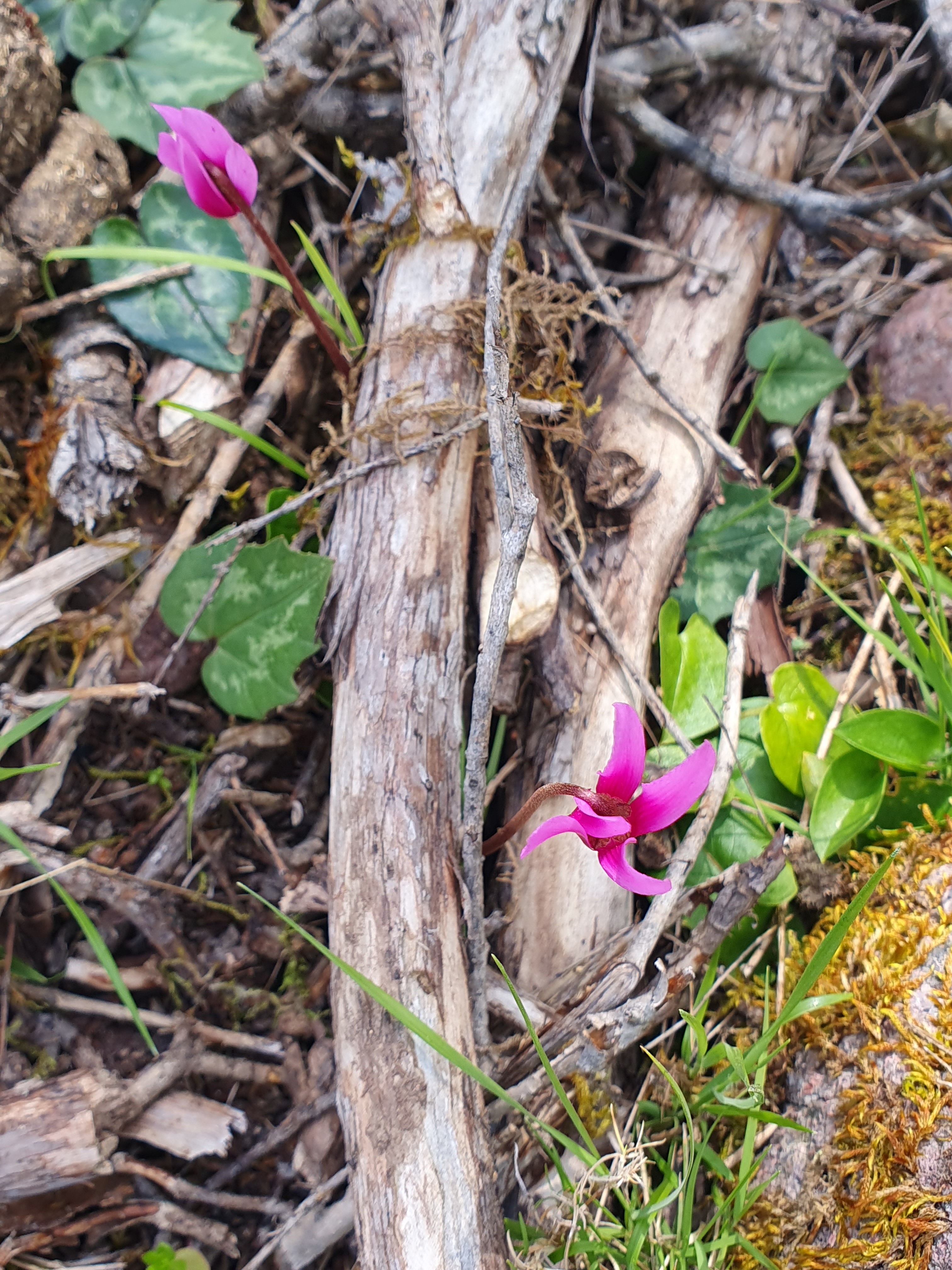
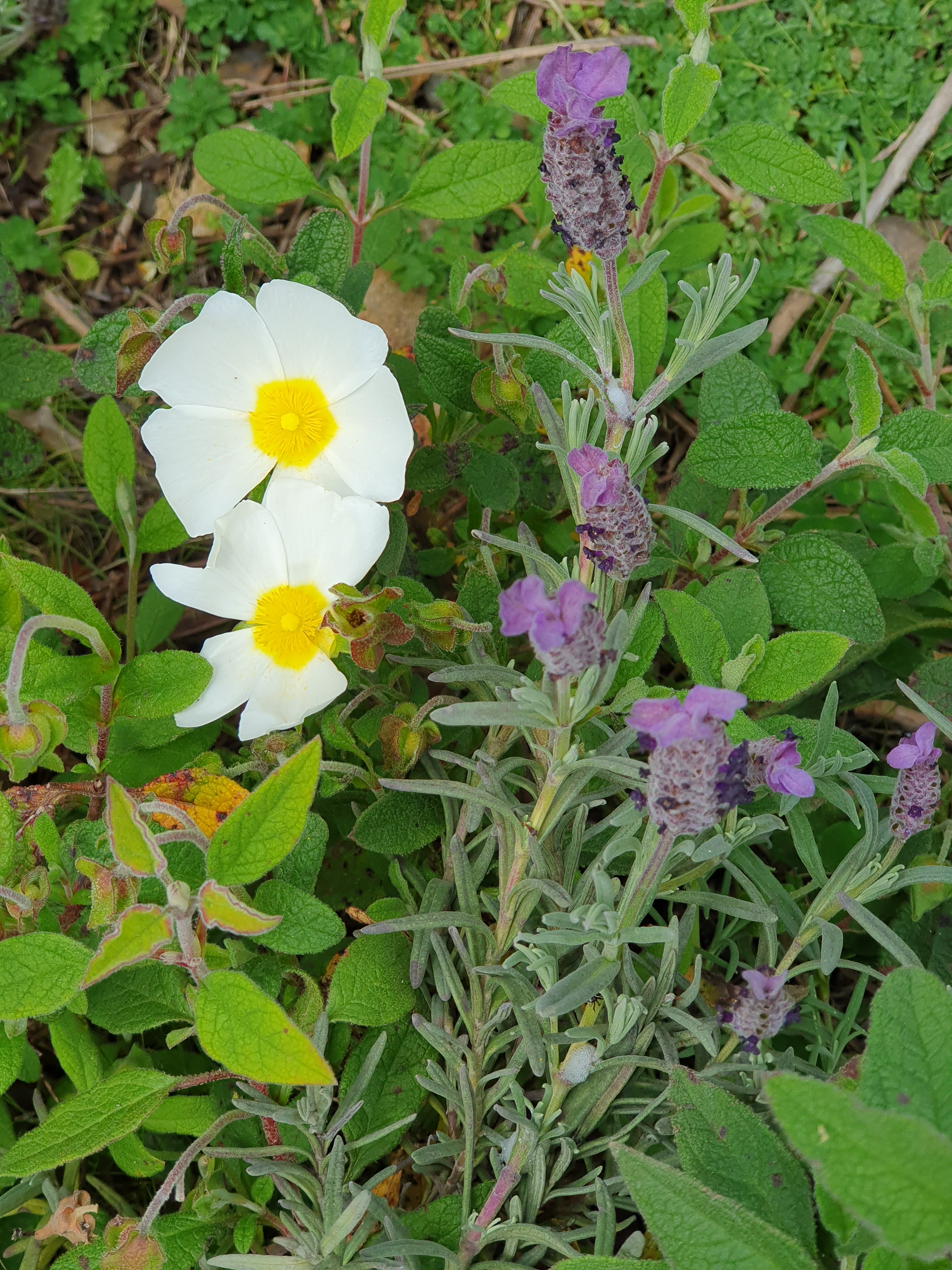
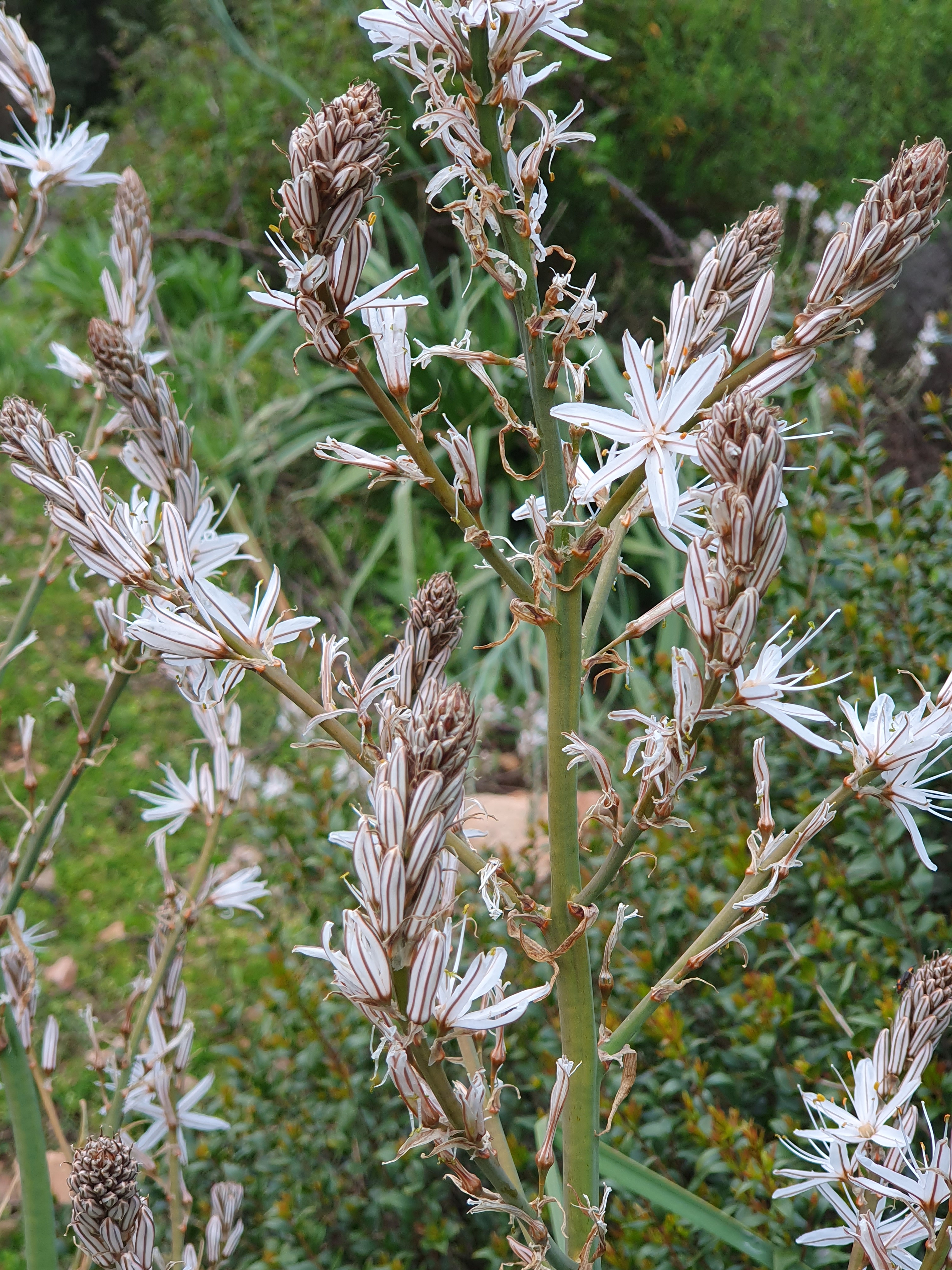
At the foot of the mountain, dense forests, giant geraniums, asphodels, irises, wild lavender and cyclamens, oleanders, enormous cacti, and bougainvillea in bloom; the scents of spring; red-throated robins hopping from one Mediterranean shrub to another on shiny-leaved branches; cheerful songbirds; peregrine falcons with broad wings gliding and circling (a tenth of the global population is found here), stray cats lurking on a warm rocks or lounging on empty terraces with infinity pools…
In the valleys and along the transhumance trails, there is no cellphone service, and Google Maps is clueless around here. This is an island made to resist outside domination, in whose rugged nooks and crannies you feel like you can still escape the rat race. Lose your way, lose yourself, never to be found again.
Bring sturdy, comfortable hiking boots: rough, jagged trails and scree await you.
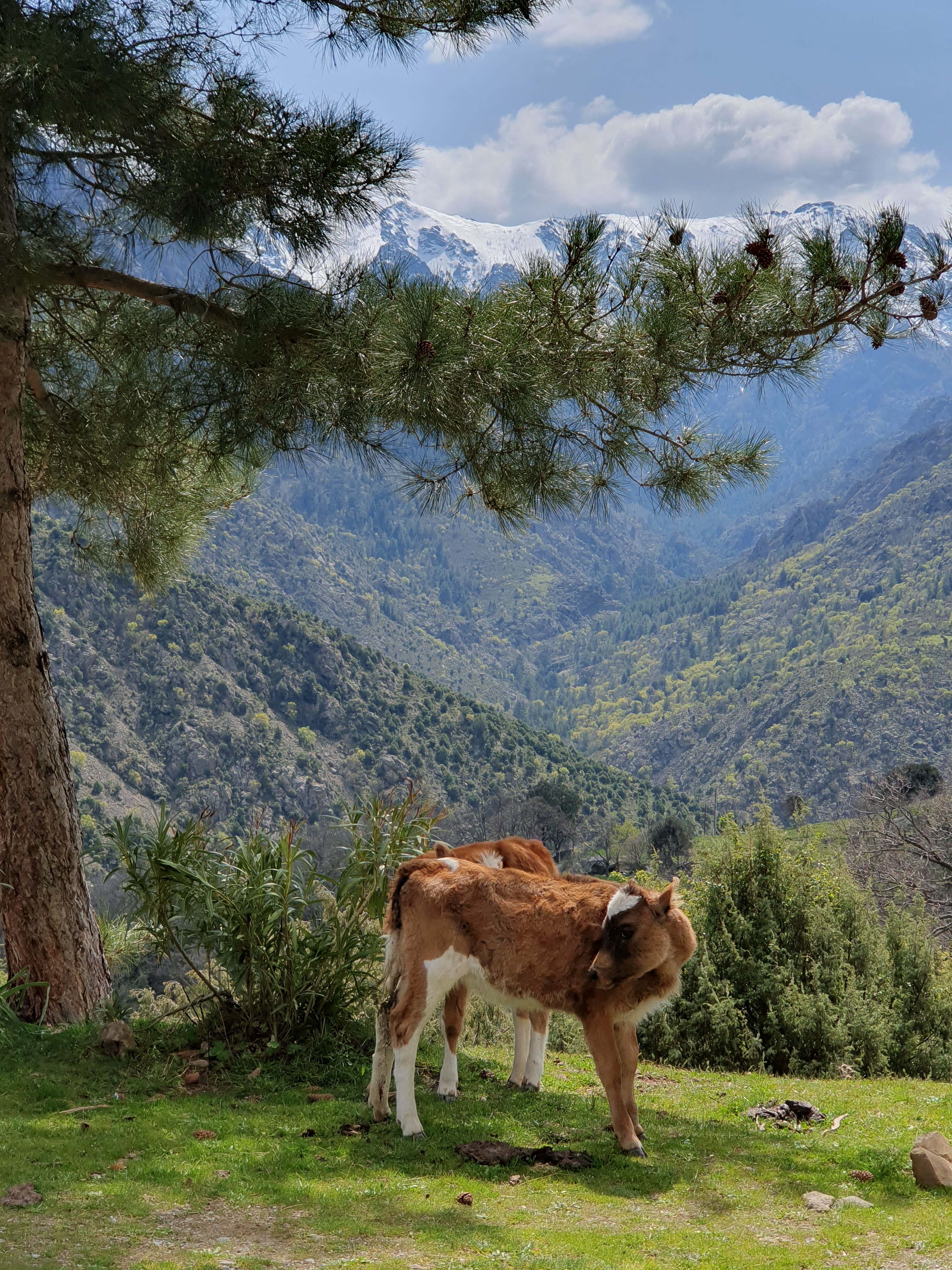
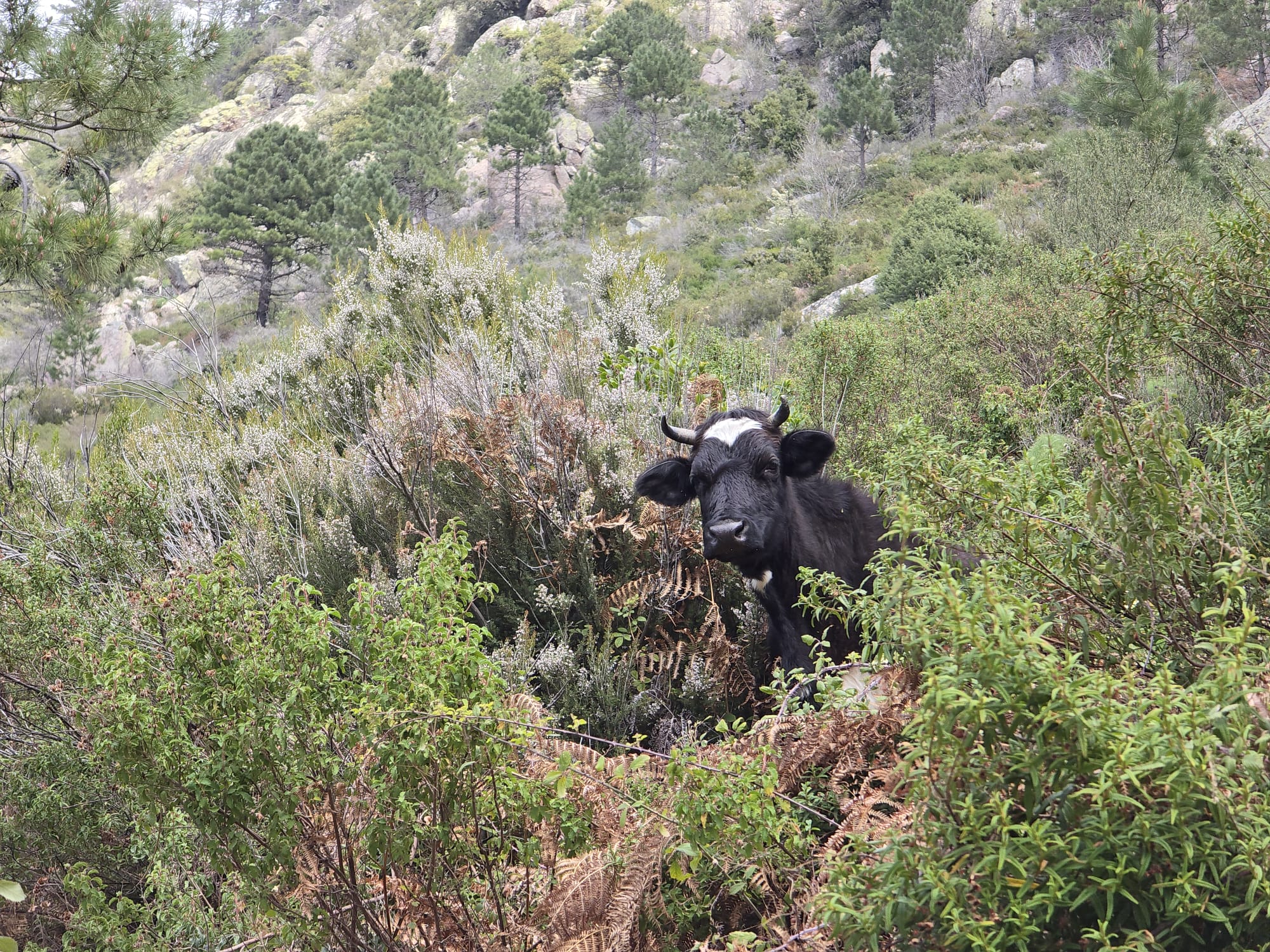
In front of us, lizards scuttle. Not a soul in sight. Two partridges (or pheasants?) suddenly dart out of a nest at the edge of the path and startle us. From among the juniper bushes, two round, moist cow eyes suddenly fix on us. The shy animal is grazing on flowers. The calf’s horns have just begun to grow, and it has fluffy fur.
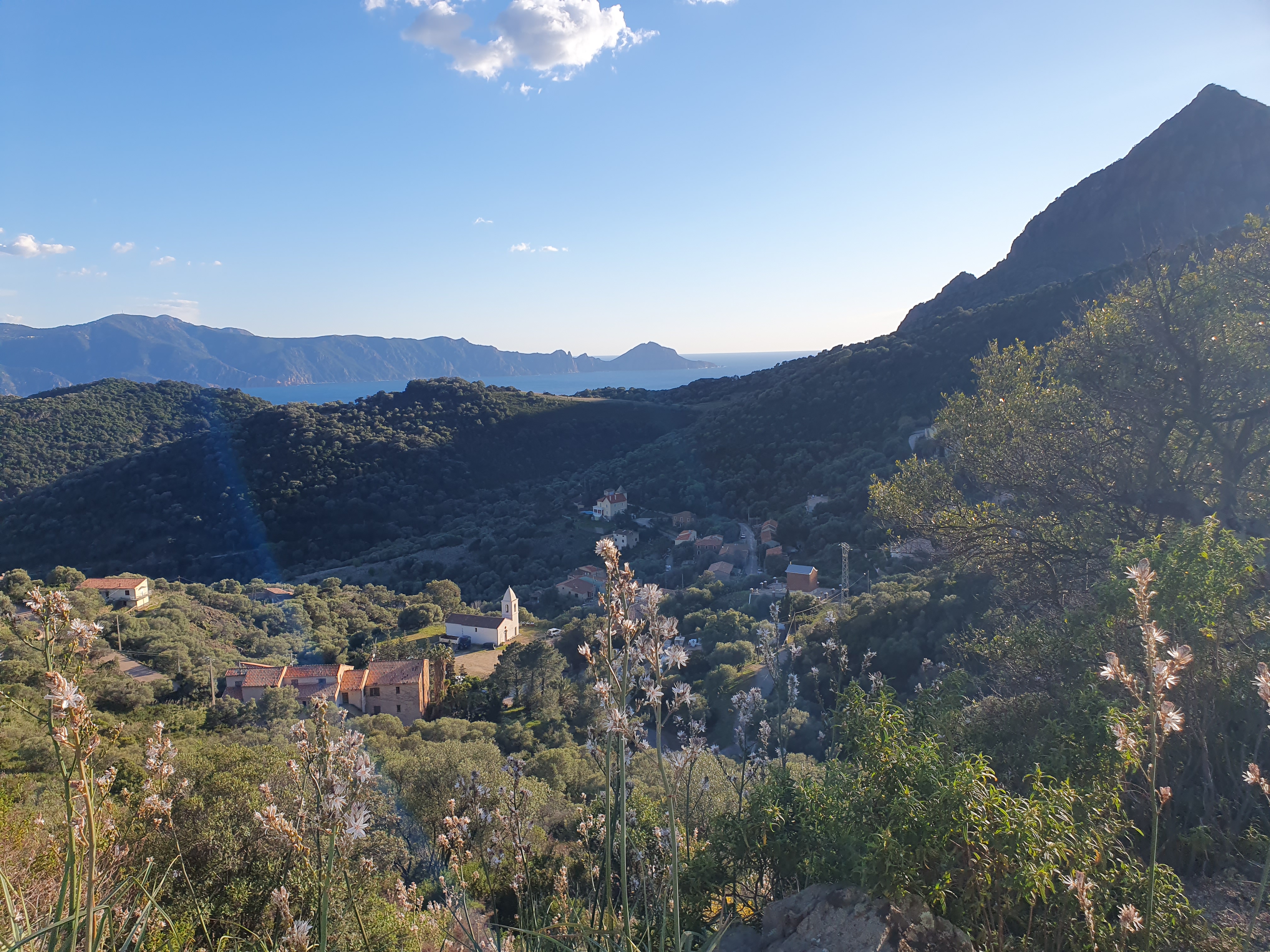
Here and there, distant, sparse, and clinging improbably to the slopes—villages and farms that eke out a living from organic vegetables and livestock (cows, goats, pigs), from vineyards and beekeeping, from specialties of cheese (the most famous of which is Brocciu).
The cows—brown or black, scrawny and small, agile, climbing to where you would least expect to find them (i.e. even to the rooftops of long-abandoned homes) for a tuft of grass—seem half-wild. They roam freely wherever they please alongside their calves; they have no bells, and not all are tagged.
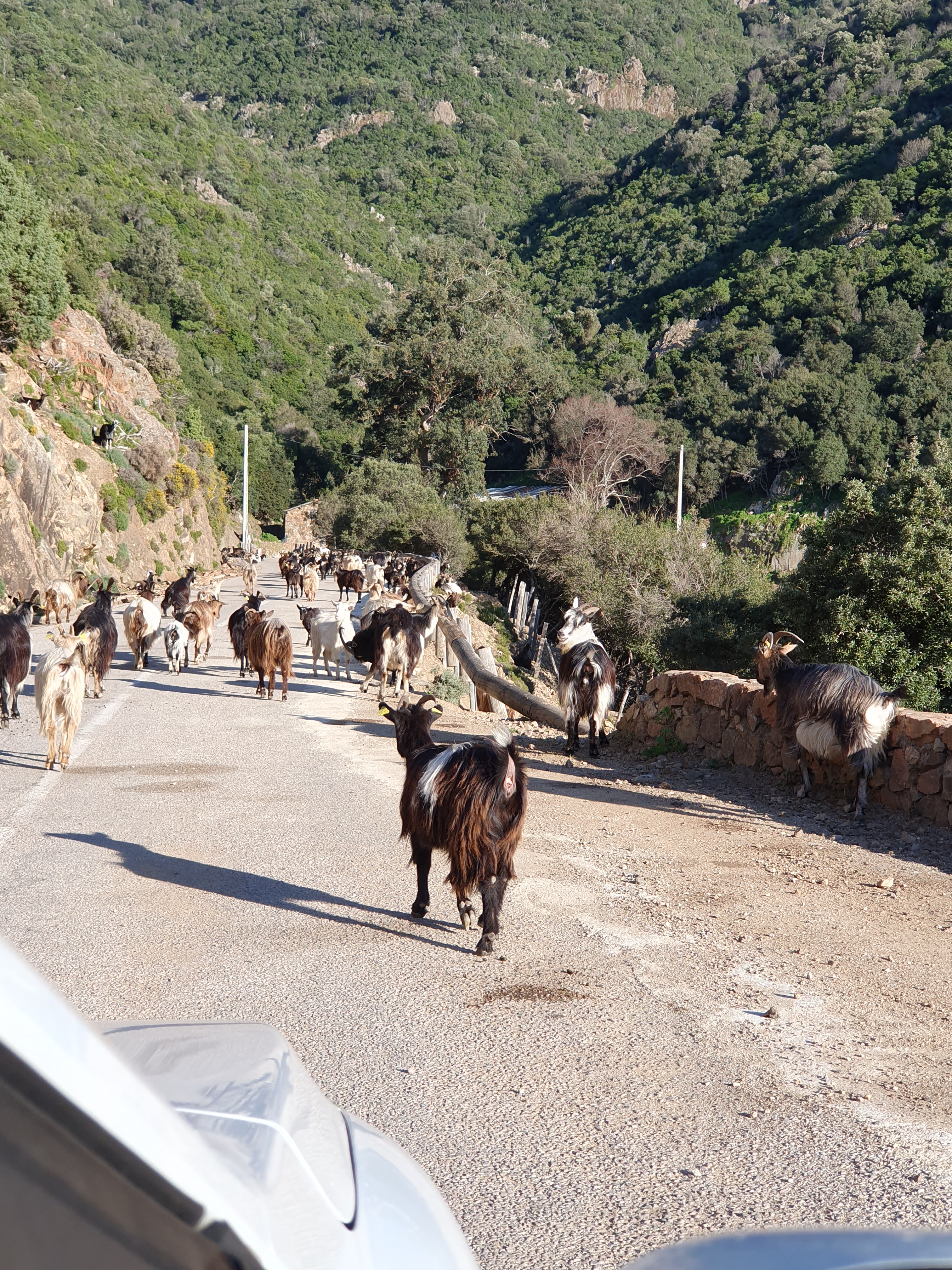
But the most agile are the goats. On the narrow, precipitous road leading from Galéria to Porto, we come across a herd of several hundred, crowded onto the road or scattered across the steep slopes above it. I have to herd them toward the edge of the asphalt so they clear a lane and our car can pass. From above, on the cliffs, their hooves dislodge a hail of small rocks. One of the goats is limping. Others (the billy goats) butt heads, pouncing on one another. Still, they are docile and oblige. We make it through the herd in five minutes.
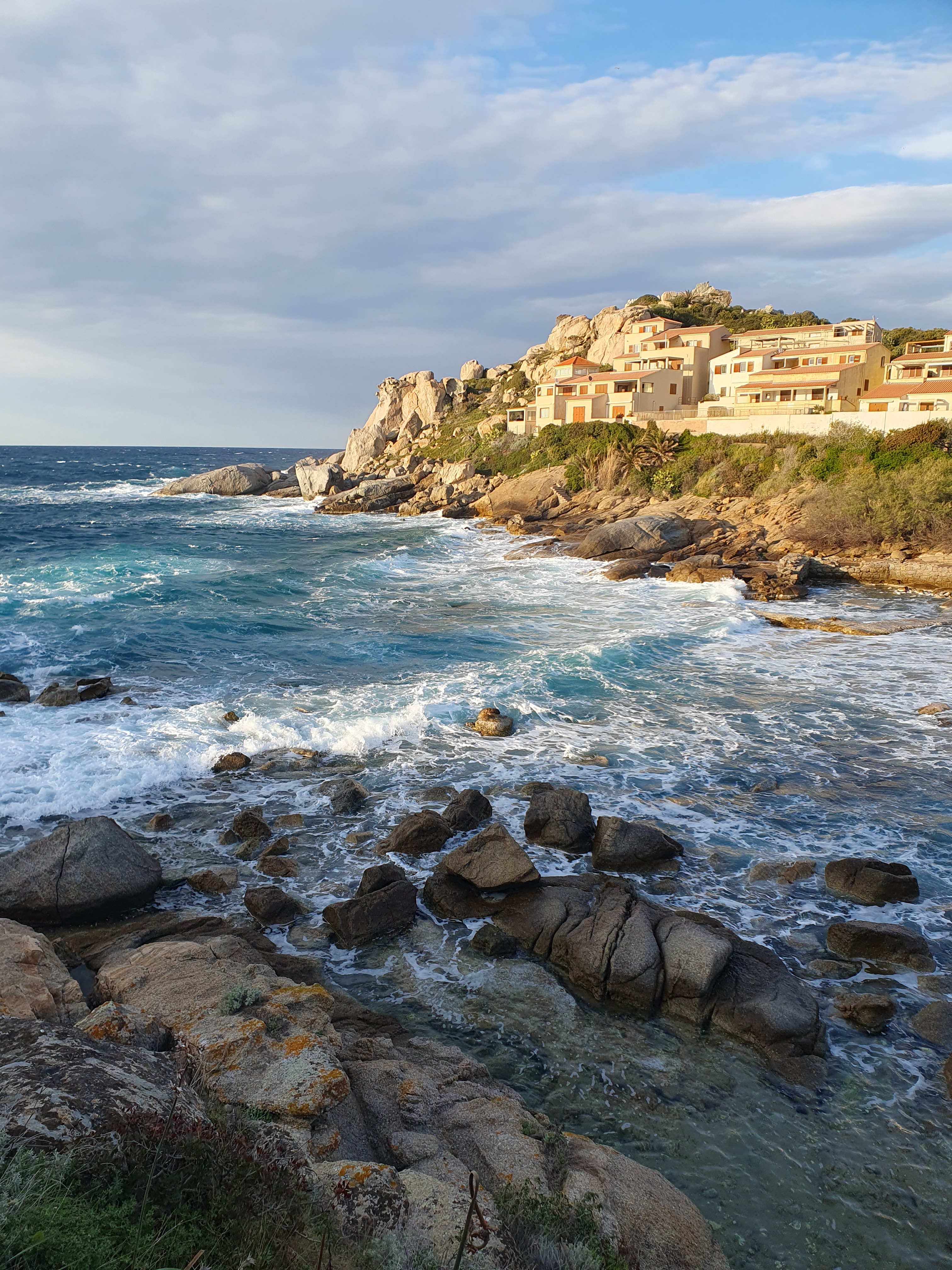
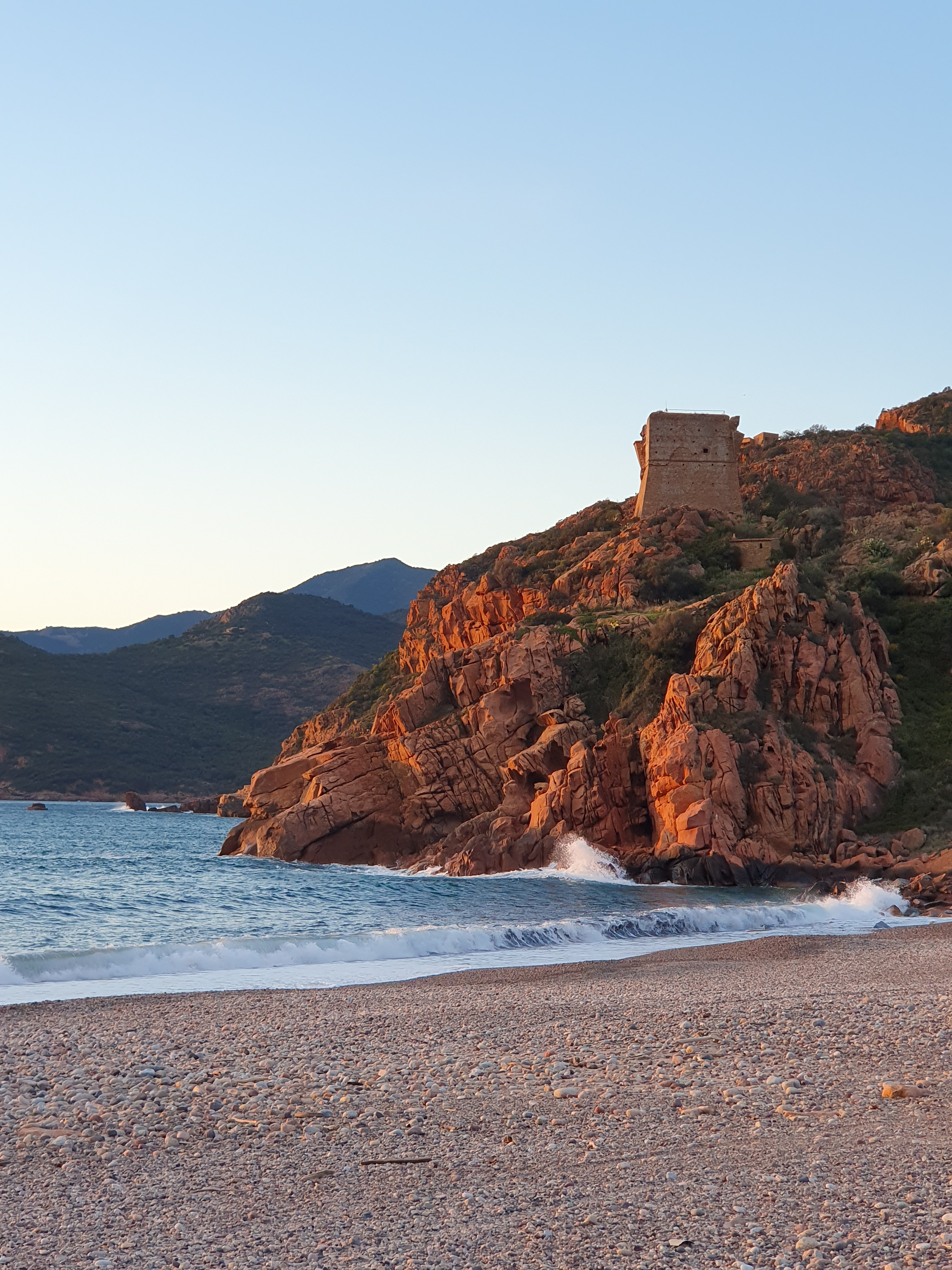
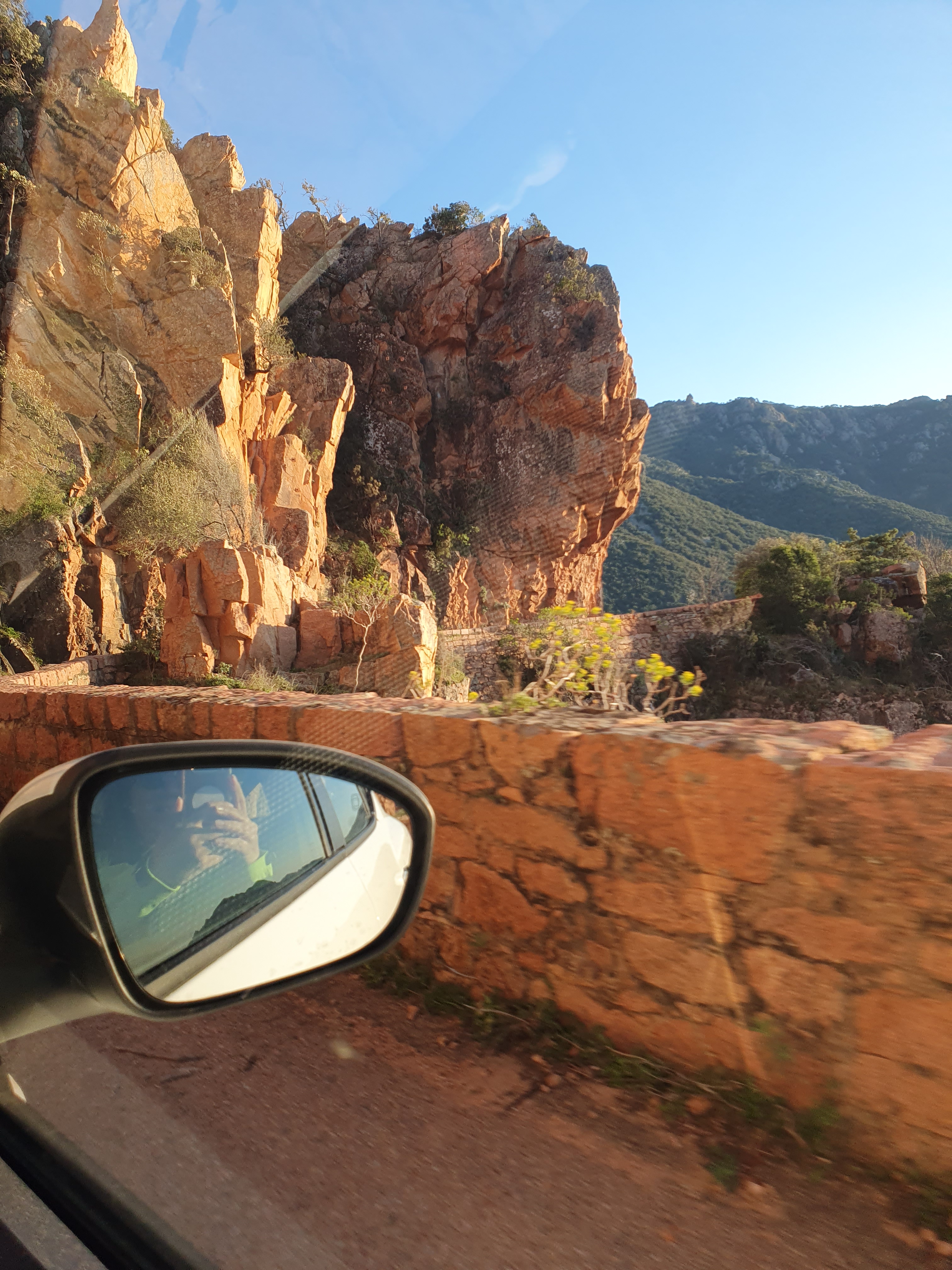
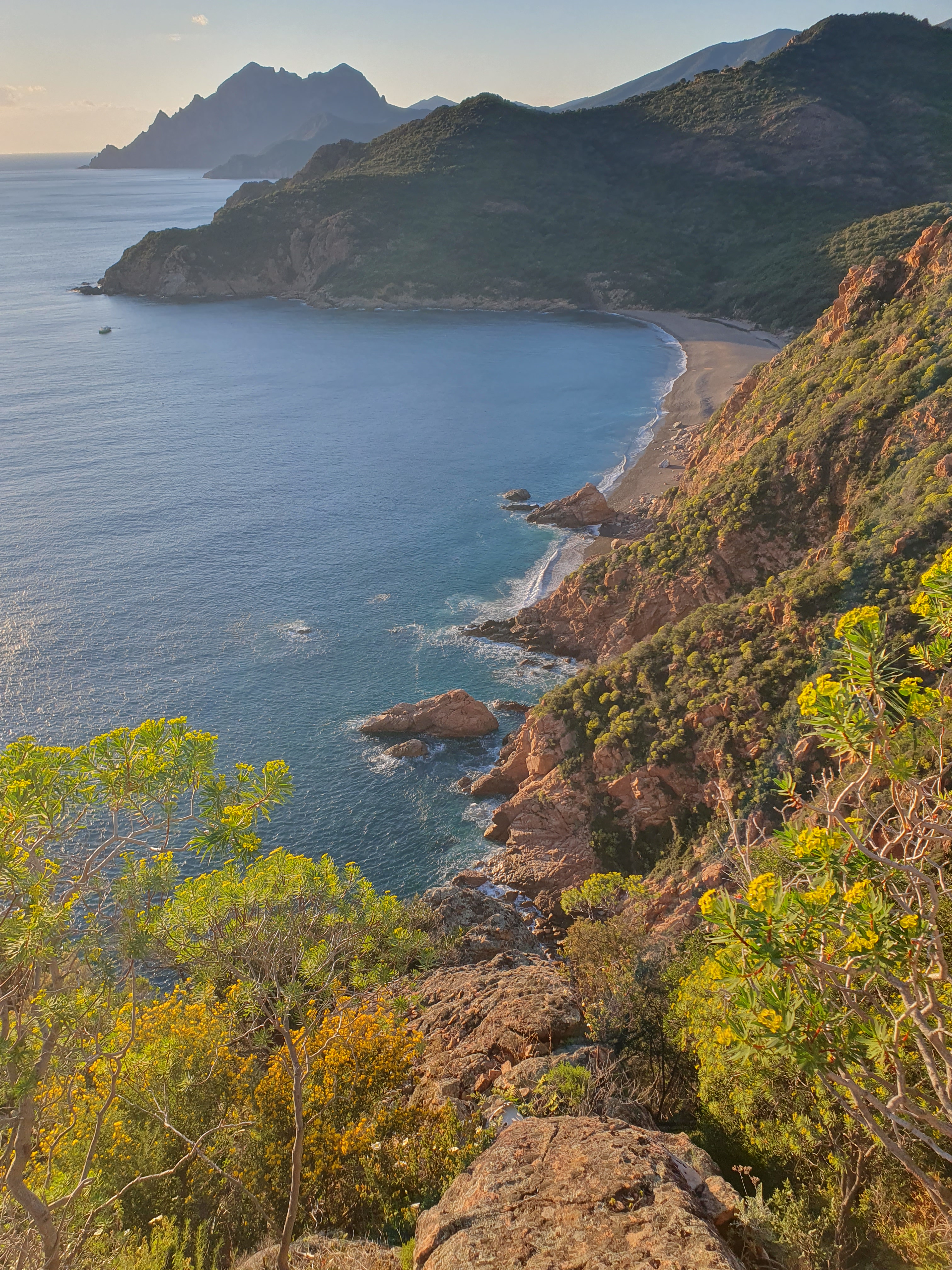
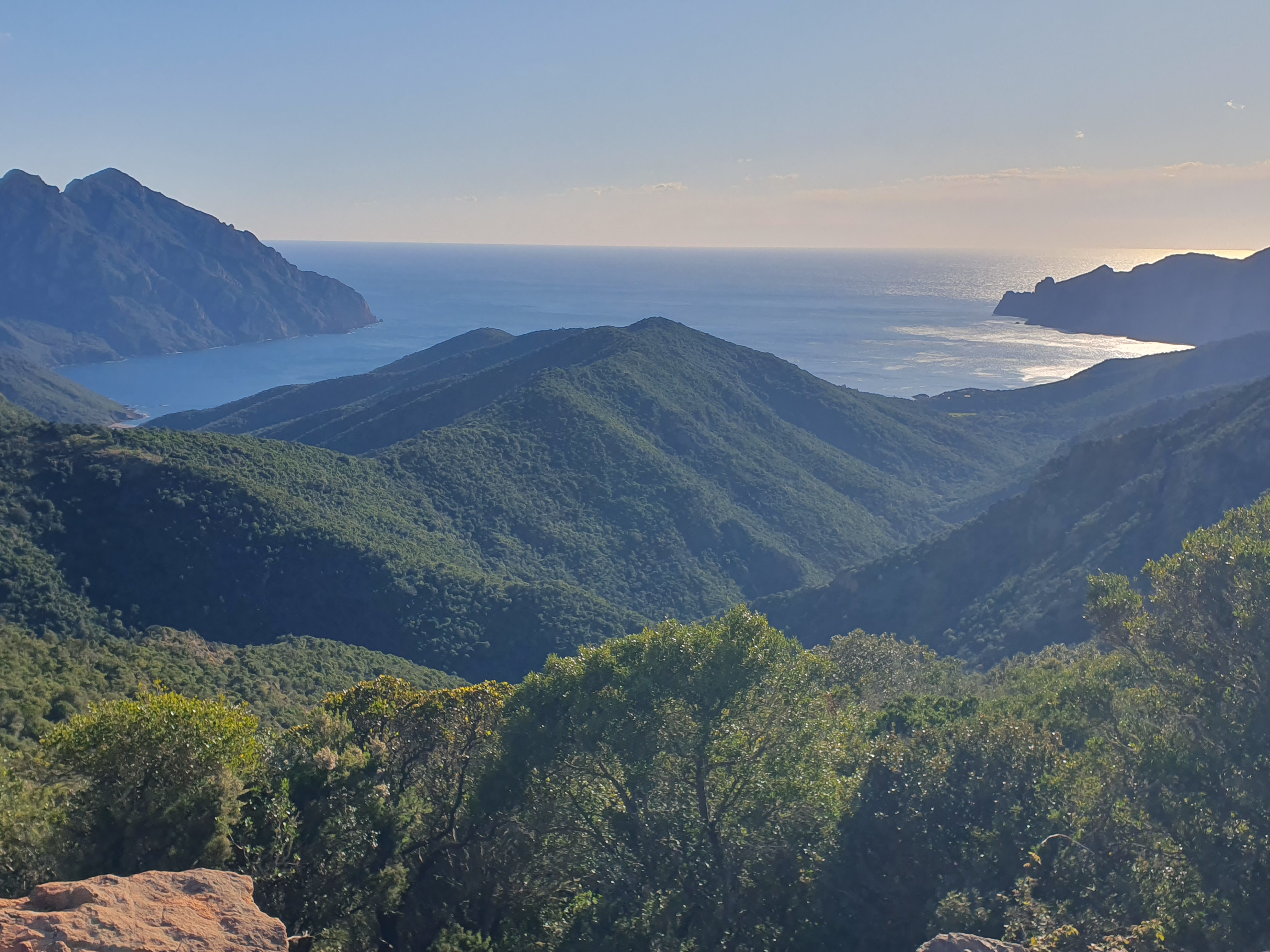
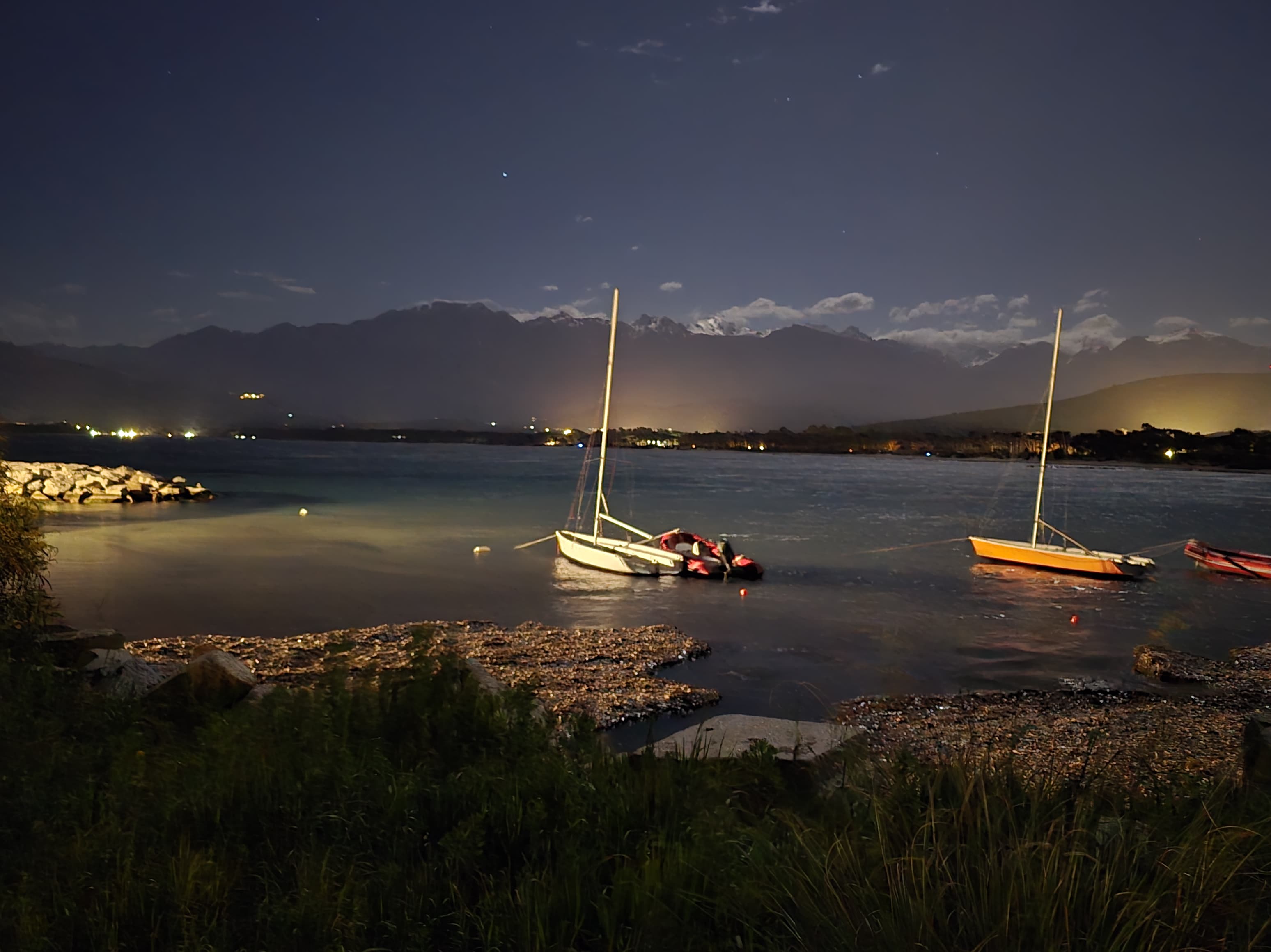
And then, at the golden hour of sunset, we turn into the most splendid bay the Mediterranean has to offer (a UNESCO World Heritage, too), and suddenly find ourselves on another planet. The splendor is indescribable. In front of the car, a cyclist pedals at 40 km/h (we cannot overtake; it is impossible to drive any faster on these winding roads of patched asphalt surrounded by wonders of savage beauty). Below us, the rosy-red wall of the “calanche” plunges vertiginously, vertically, several hundred meters toward the water of the bay. I’ve long since run out of words.
We grab a bite to eat on the beach in Portu, sheltered by the lifeguards’ hut, but a fierce wind is blowing in from the sea, and the sunset is freezing cold. We return through the calanches after the fall of darkness, and a wild boar cuts us off. Then another, and another… By the end of the evening, we’ve counted 11 encounters with their curled tails.
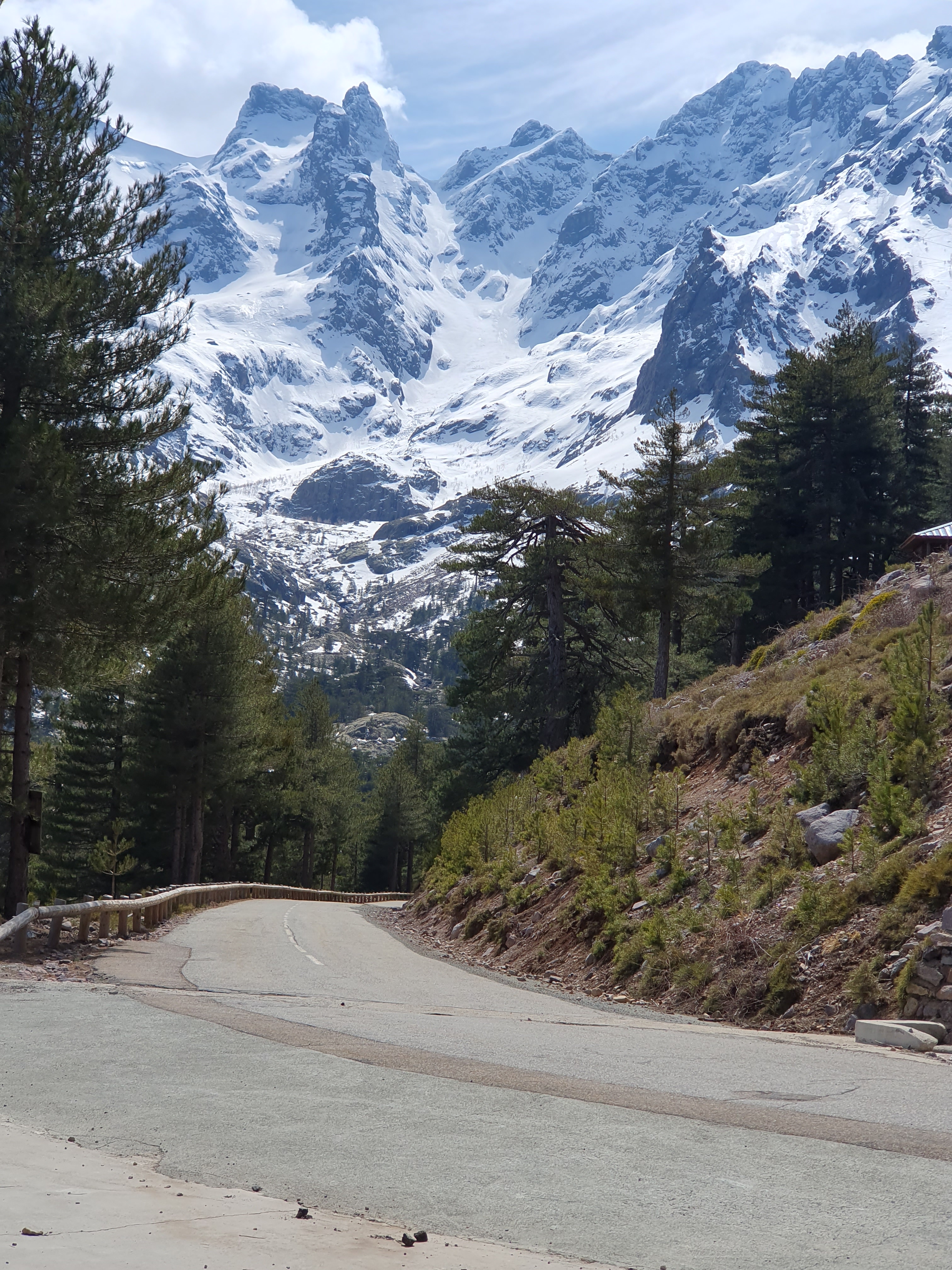
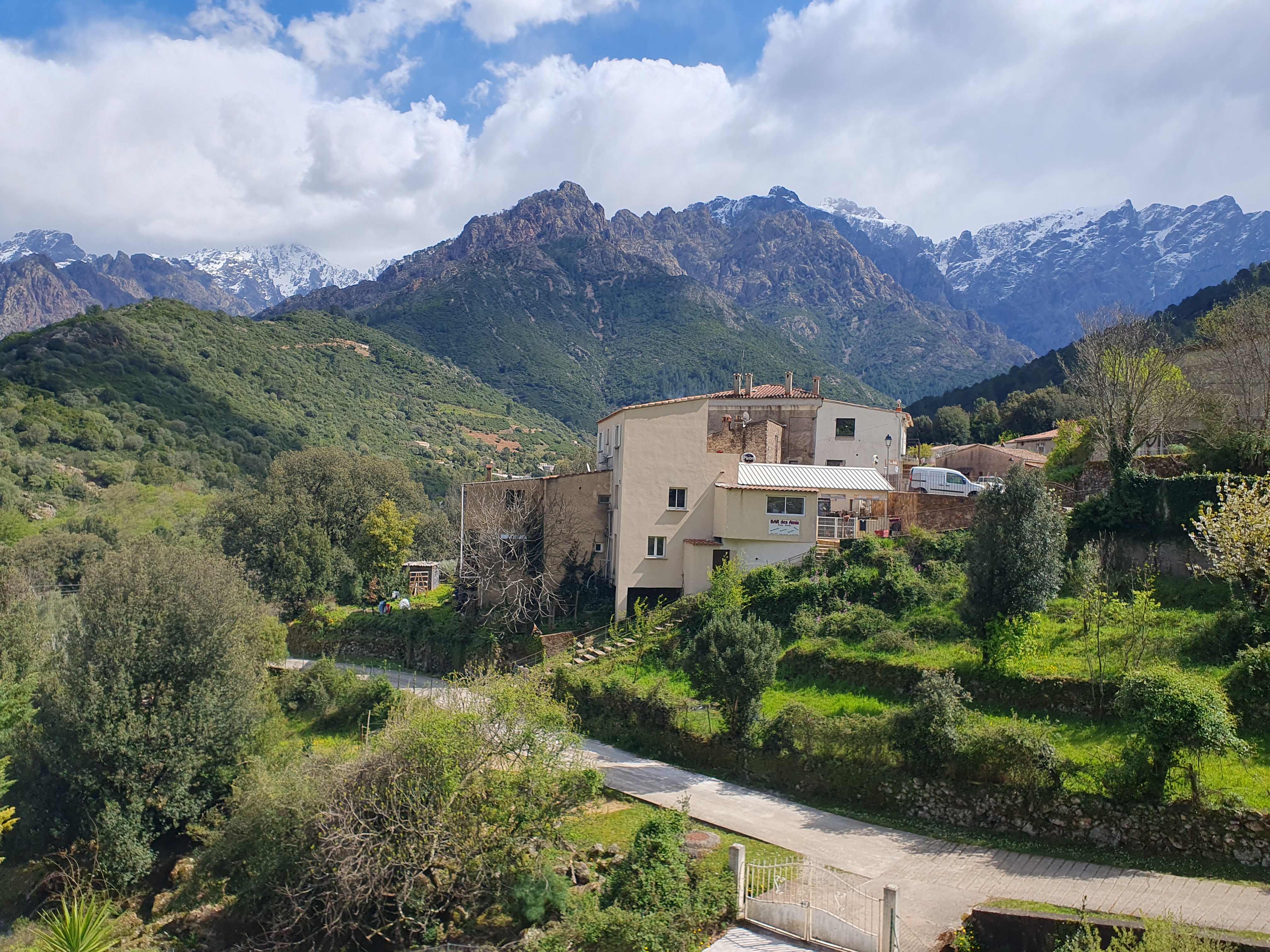
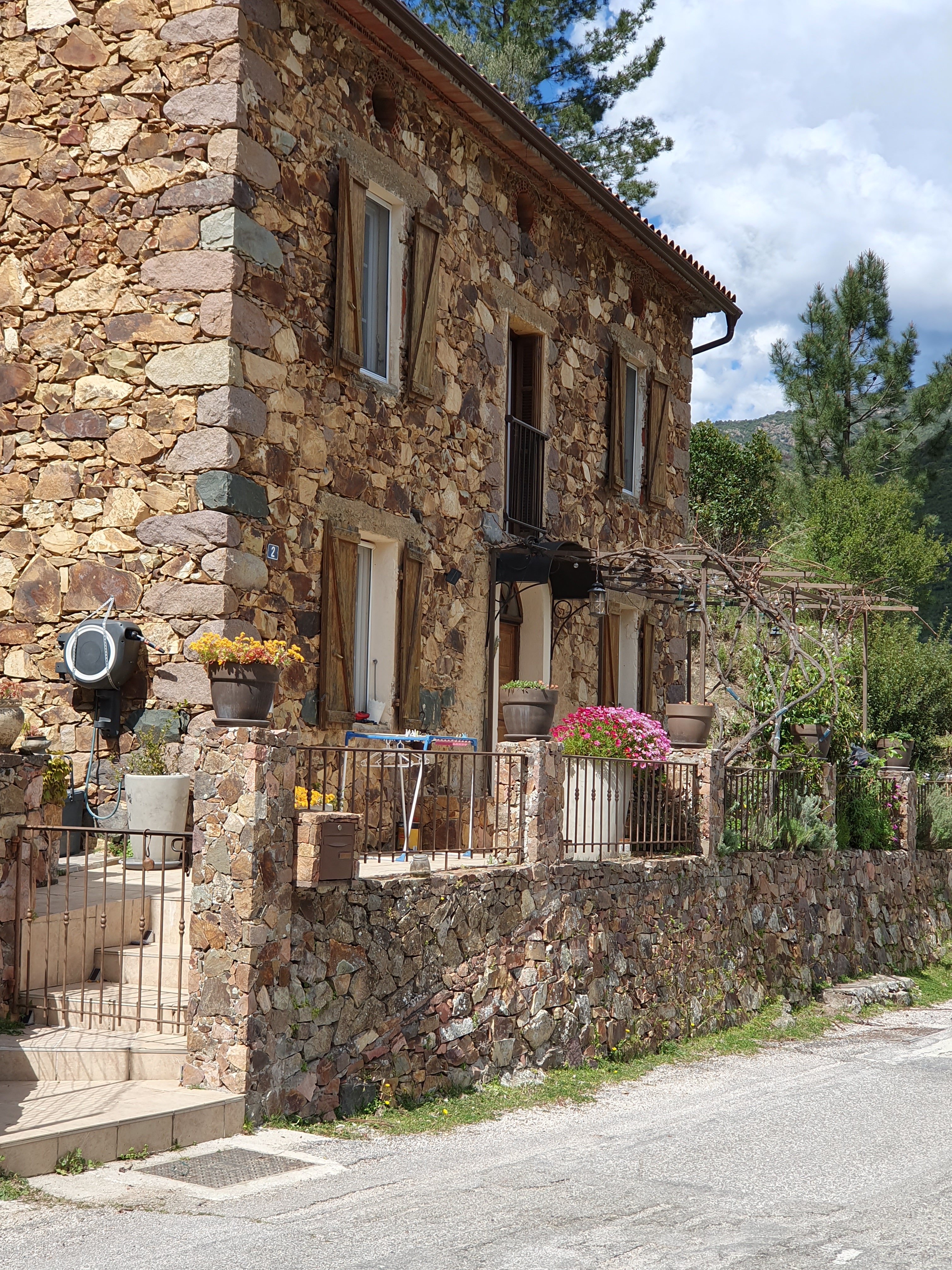
The roads in the valleys and along the high coast are narrow and quite worn, uncleared of falling rocks, and, though they wind dizzyingly, they often lack guardrails. In a way, though, we’re glad: the Corsicans don’t encourage mass tourism. We don’t like it either. We prefer authenticity, we’re travelers enjoying the journey, the discovery. On the other hand, unlike us, the Corsicans drive like certified maniacs. They’re so used to speeding that we find speed bumps even in tiny villages deep up beyond the mountain passes. Inland, the houses are spartan, simple structures that preserve the traditional local architecture: parallelepipeds built austerely of natural stone (black and brown granite), with tiled roofs. Most of them are now closed, shuttered. With their windows bolted behind airtight solid wood, they look to us like armored cubes, capable of withstanding even the harshest weather.
The locals on the farms go about their business and pay us no mind. In general, it seems Corsicans don’t readily indulge in small talk with strangers. Or foreigners. (They resisted both Genoese and French domination and still do.) In Montestremu, at the end of the paved road, a middle-aged man lies sprawled in an old armchair on the corner of the street and says nothing.
Among the bushes in the Fangu meadow, we find the remains of a small campfire where hunting cartridges were burned. Probably poachers, judging by the wild boar tracks further down the path, and by the signs at the town hall in Mansu, which list the areas where hunting and fishing are prohibited during this season (the so-called “no-kill zones”). All over Corsica you’ll find road signs riddled with bullet holes (not as many as 21 years ago, but still).
Just as common (but rigorously mapped and marked) are the chemical fire suppression tanks (it’s not drinking water, don’t drink it!), as well as the blue and red plastic markers on the slopes of the villages, which indicate, we surmise, the route of the underground water pipes to which firefighters can connect if necessary. For lack of a centralized collection and recycling system, up in the mountains (but not only), in early spring, the local farmers burn plenty of dry twigs and other types of waste in their yards. This is a pity, as it fouls up the air and is also a fire hazard.
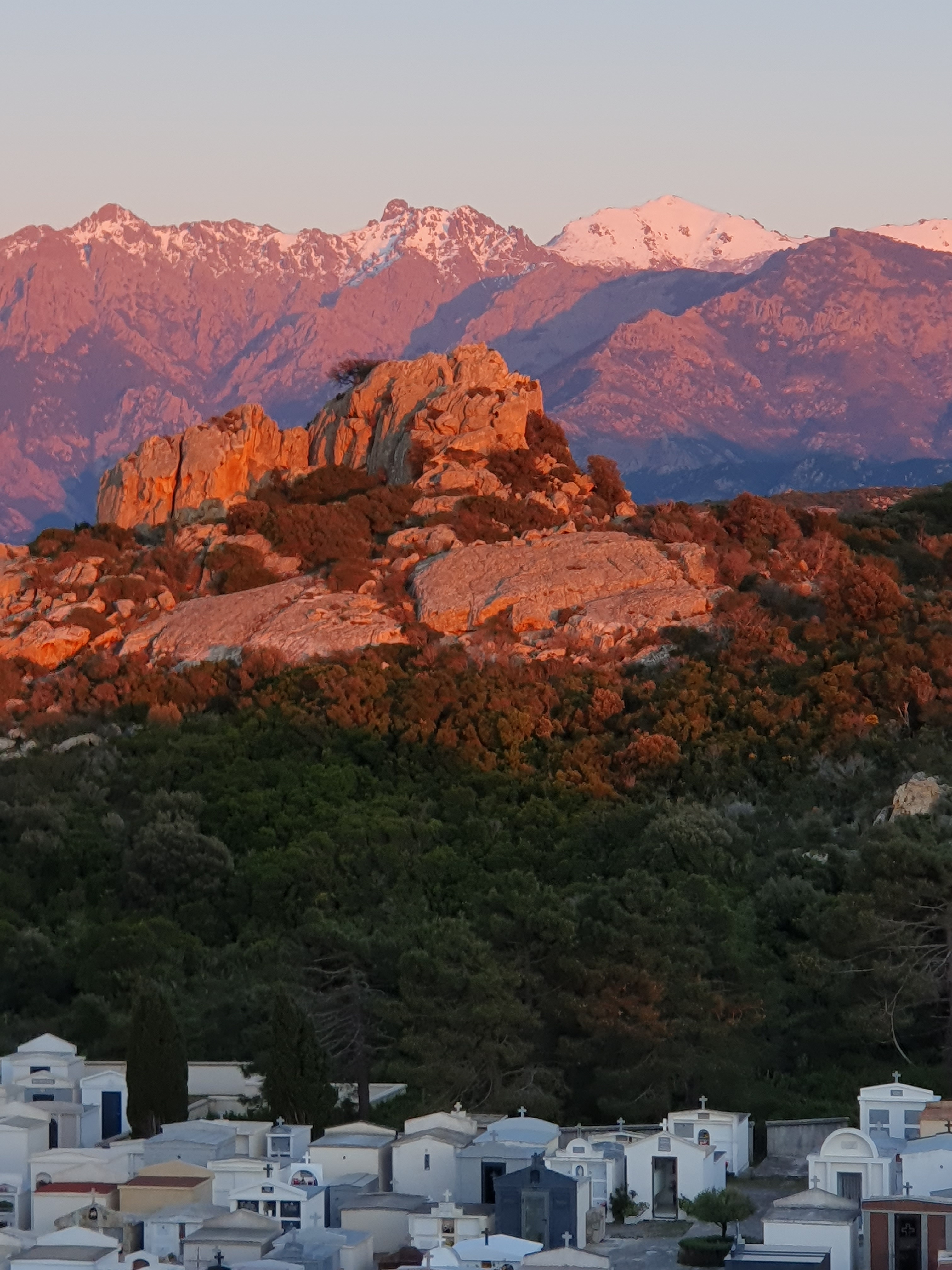
In Calacuccia, at an altitude of just 850 m, we are close to the snow line (the ski resort is 23 km higher up), and the thermometers show only 7°C. The real feel is lower, despite the island’s Mediterranean location at 42° N latitude. We find ourselves forced to put on winter jackets, hats, and gloves. We are surrounded by snow-capped peaks and gray clouds; nature hasn’t awakened yet, it seems stuck in winter. The road from Corte (Corsica’s unofficial “capital”) to here was a seemingly endless, narrow gorge with steep, weather-eroded edges, viaducts carved from the same rock as the cliffs, and daring pine trees. A road reminiscent of the Transfăgărăşan from the ’80s, but in a landscape that seems like it’s been transplanted here from another planet. You feel every bit as isolated as you would on Mars, and the rock is just as reddish. Then, suddenly, high up, an open plateau, poplars, deciduous trees not yet in leaf, and a rundown Franciscan monastery, which nevertheless offers guest rooms and whose woolly little cow stares at us through the fence with big Bambi eyes.
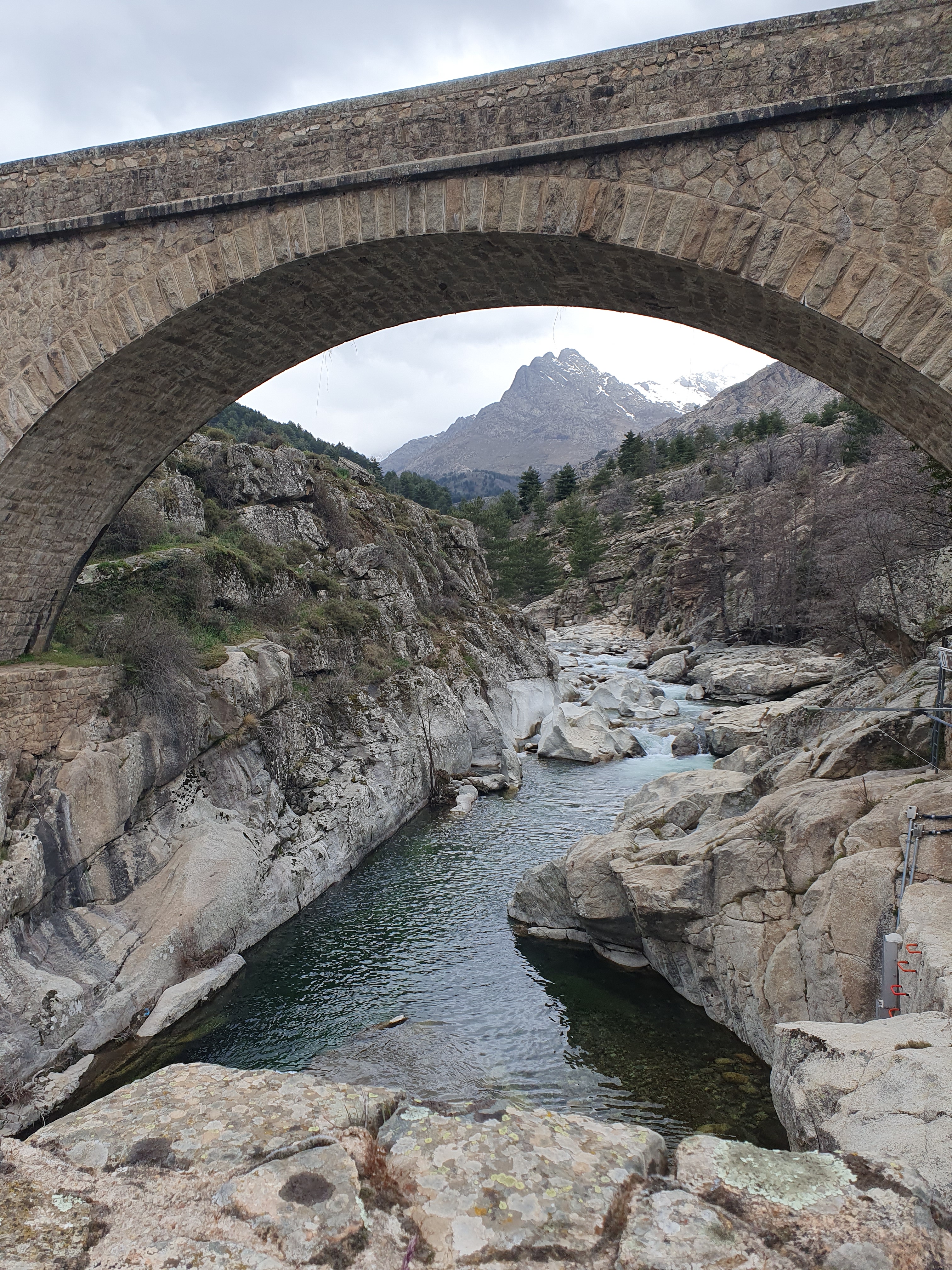
The small town, with its shutters closed and at this time of year almost deserted, is undergoing extensive renovation. Cables have been laid, and work is underway on the road where a stray dog wanders alone. The two stone bridges in Albertacce (the old one, for pedestrians and donkeys/horses, and the newer one, for cars) add a special vintage charm to the landscape, and the Golu River canyon—with its typical natural pools, like those of the Fangu—is fabulous. Its water looks like jade today. We feel instantly rejuvenated by the sights, despite the biting cold. Black pigs graze freely in fields of asphodel, turning over stones with their snouts and roaming the village unhindered. We also see sheep. An arctic wind whistles. On what Mordor-like serpentine roads will we return to the gentle port of Calvi?
Although the tight curves hidden behind rocky cliffs or suspended above enormous abysses may seem frightening, what drives you mad on this island in winter and spring is the furious and almost constant wind, which whips your body and bites into your flesh. It blows so hard that it snatches the phone from my hands. I don’t want to leave Corsica, but when I’ll have to, I wish for only one thing: a calm sea.
Did I mention that Romanian workers can be found everywhere in Corsica? Even at the Stagnu Refuge in Ascu, a tiny ski resort nestled in a fabulous mountain setting at an altitude of 1,500 meters, directly below the peak of Monte Cintu (which, at 2,706 meters, is Corsica’s highest and snowiest peak), we come across Romanian construction workers, busy with renovations. As we hurry past them, it seems to us that they might be speaking Corsican, that is how similar the two languages are. We therefore address them in French, and they reply in kind. Only a minute later do we make out the Romanian words in their brisk conversation.
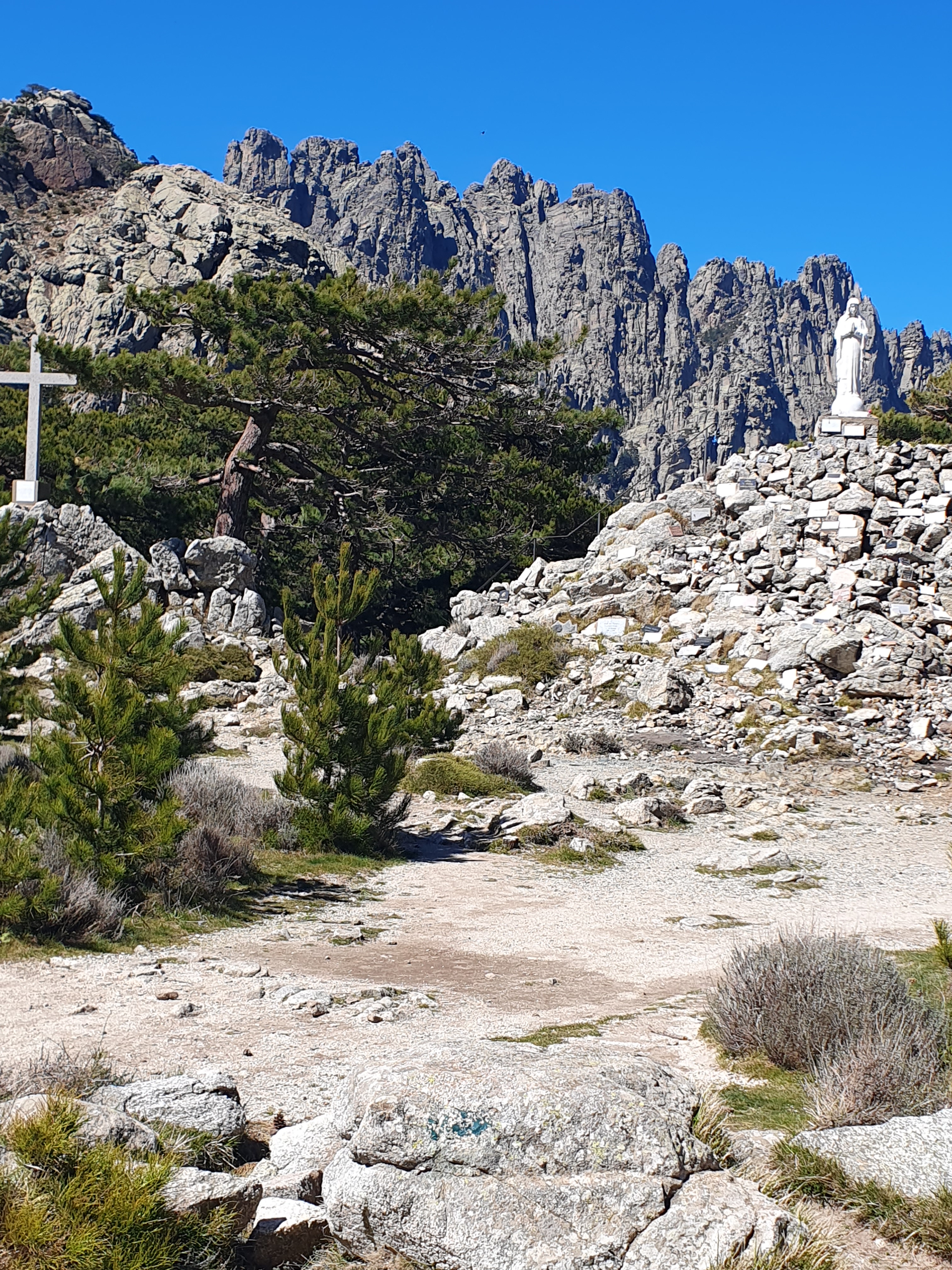
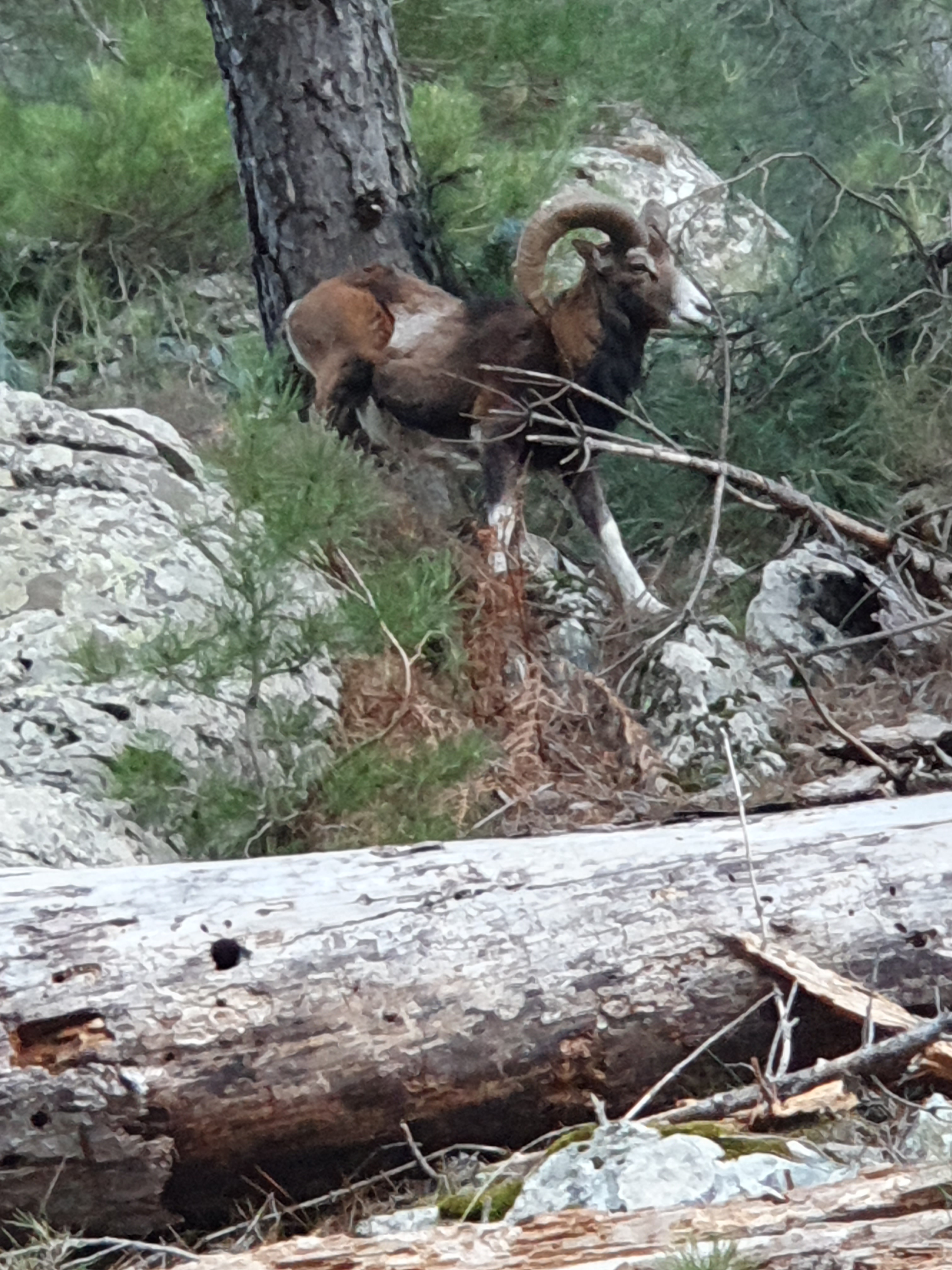
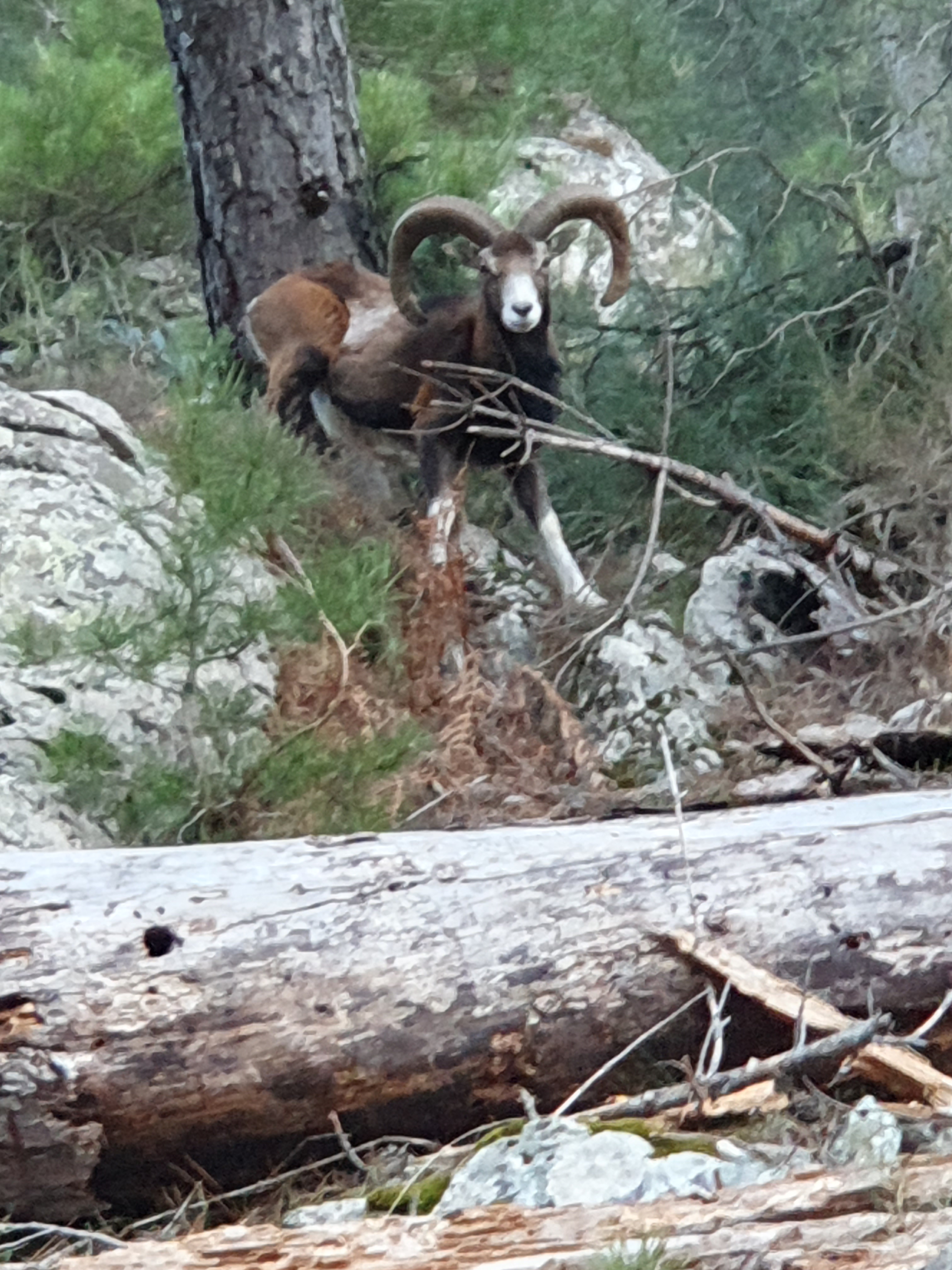
In Ascu there are famous waterfalls, on another Martian-looking slope of red granite. And it is also in Ascu that I fulfill an old dream: to hike up to the peaks along the GR 20, considered by many the most difficult hiking trail in Europe. And rightly so: steep elevation changes, boulders, a suffocating heat during the summer, and therefore a constant risk of wildfires. Now it is pleasant, even cool, and snow lingers on the slopes. At dusk, as we descend from the trail, we suddenly hear the clatter of hooves on the scree, and, lo and behold, only 100 meters ahead of us, two young mouflons dart toward the valley like arrows. We had spotted the animals’ tracks higher up, in the snow.
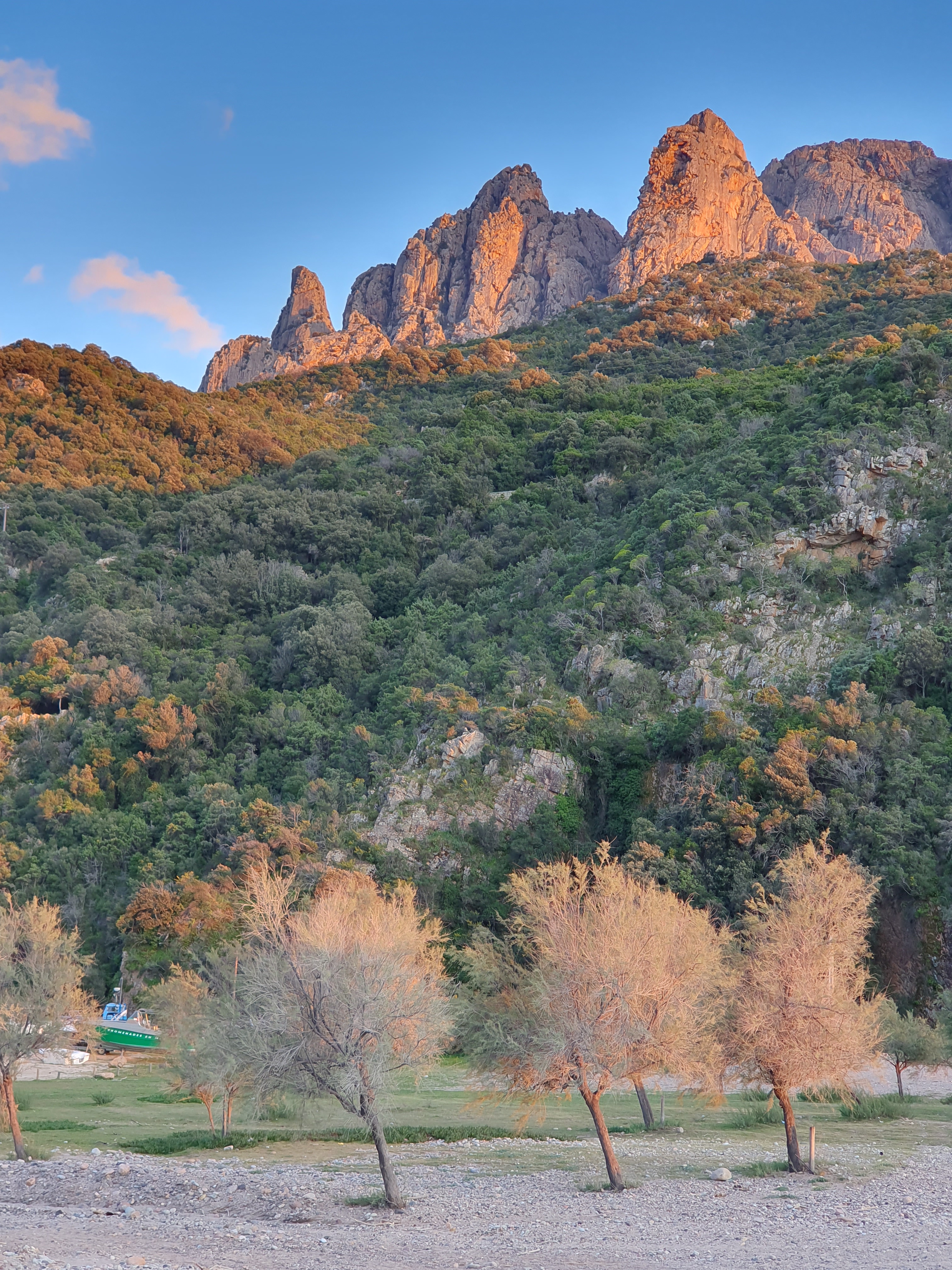
The twilight is as clear as polarized glass. In the basin with its massive rocky walls, the crenellated peaks, now reddish in the sunset, rise so unbelievably and majestically—evoking both the Matterhorn and the Dolomites—that we’re already planning our return to these parts. And further down the forest road, as we leave Ascu, another mature mouflon with two ewes in tow stares straight at us through our car window. Astonishing. Addictive. My 14-year-old daughter is ecstatic; she’s been climbing breath-taking slopes for days without complaining. And now, the reward—a unique spectacle just for us: Monte Cintu and its inhabitants welcome us into their kingdom.
We make a quick stop at the seaside for gas, cell service, and a breather. On Holy Saturday, the coast is aglow in perfect serenity. In the towns, the cafes have suddenly come alive, and it’s beach weather. We stretch out in the sun like lizards and count the days we have left. From the cliffs, the cormorants watch us with inquisitive gazes.
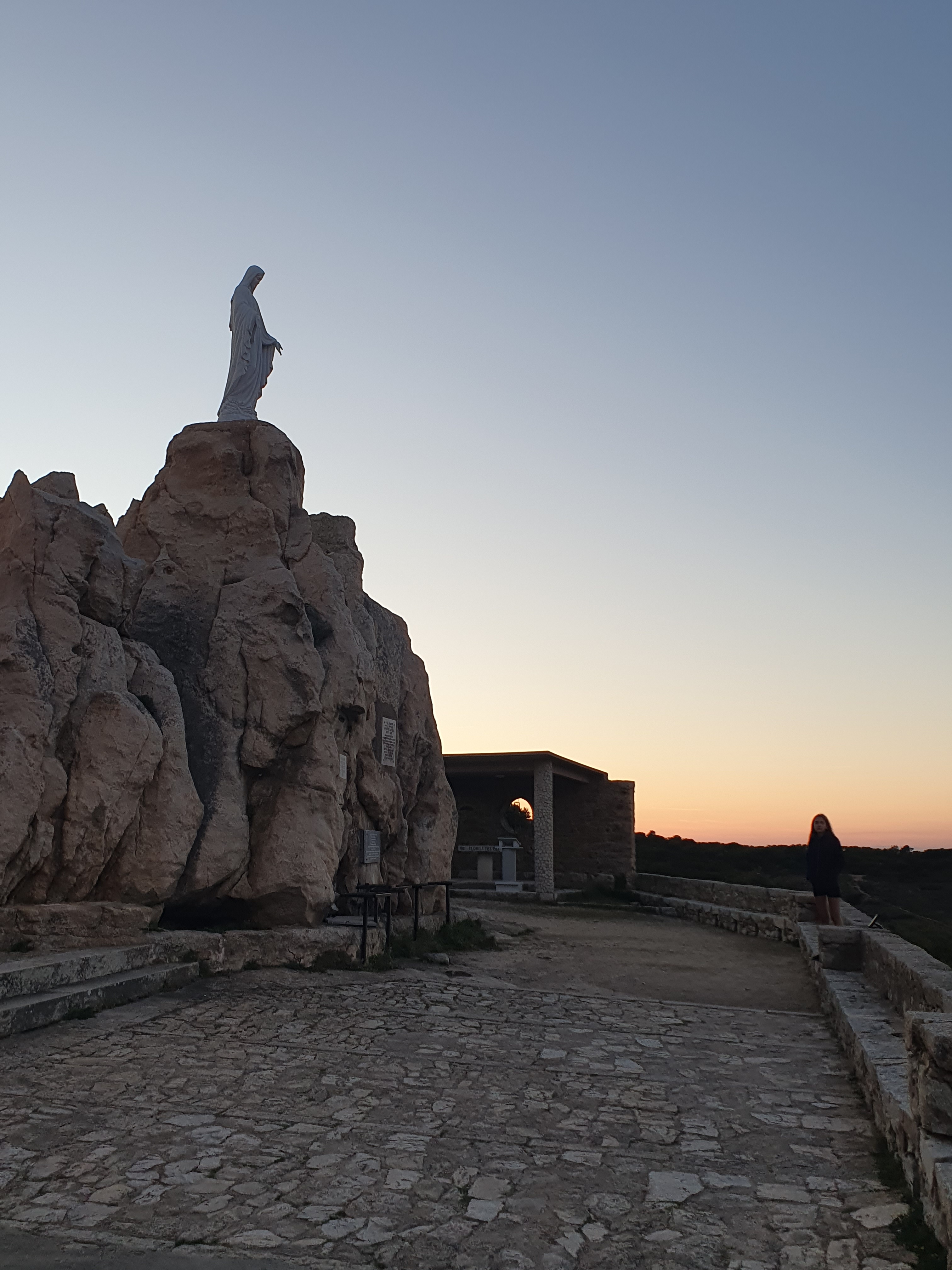
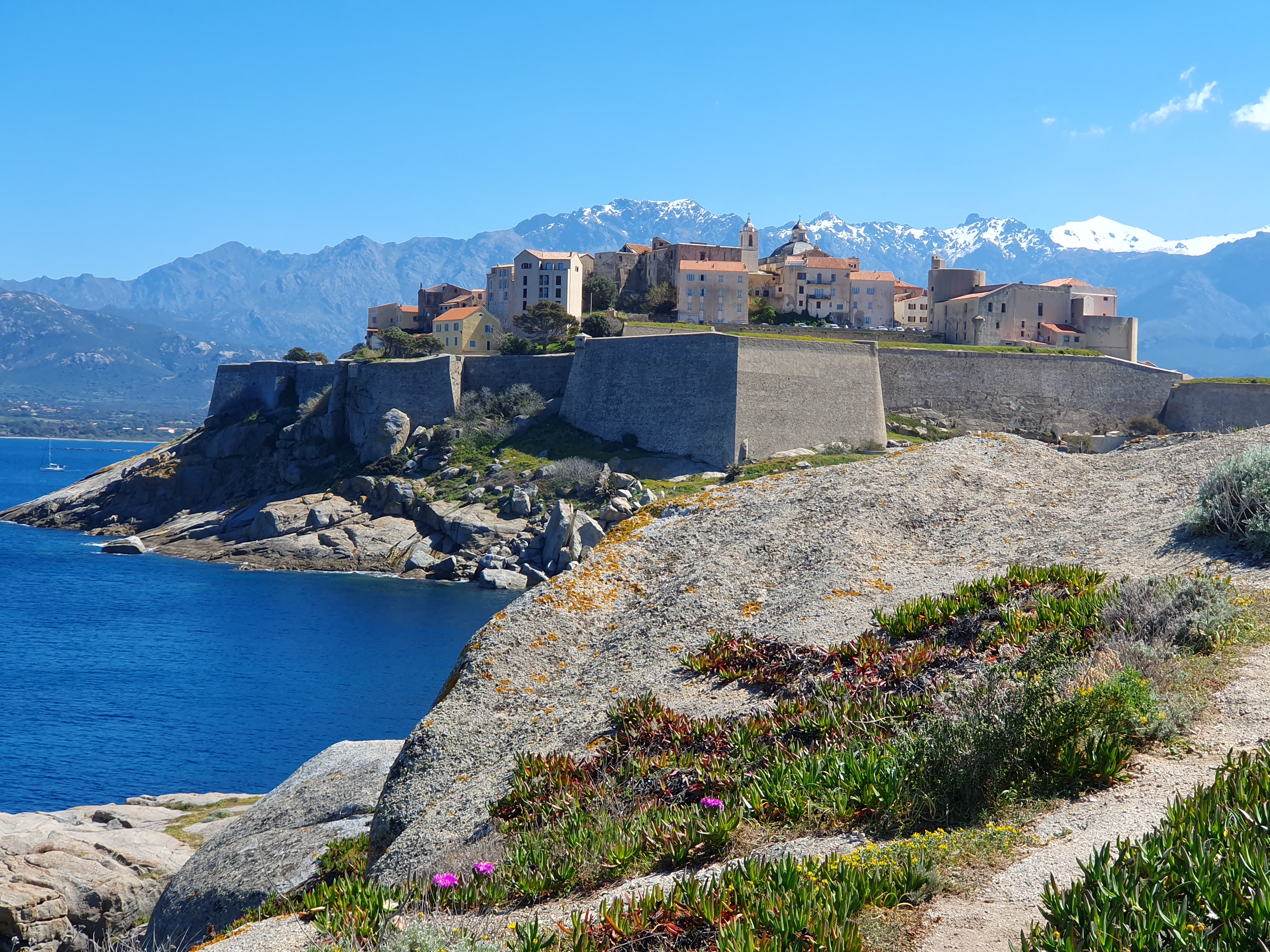
In the evening, after sunset, at A Piazzetta, we treat ourselves to an extravagance of local cold cuts and pâtés, wild boar stew with mushrooms, olives, rosemary, and thick slices of polenta, red wine, and, for dessert, a goat’s-milk Camembert with fig jam. The Gloria craft beer with wild berries, which refreshes us the following evening at Le Chalet in the harbor, is also memorable. Not to mention the panoramic view of Calvi Harbor from the Madonna di Serra chapel and the lighthouse on Revelatta: 100% unforgettable.
Corsica, an island of wild splendor, combining French flair with a rebellious spirit, still holds secrets. And we realize that there’s one thing we haven’t yet seen here: bored kids scrolling on their phones for hours on end. Instead, we saw kids laughing, running, peering at shellfish on the shore, talking vivaciously with their parents and grandparents, or playing soccer in the harbor, where they even broke a restaurant’s lamp. They were simply scolded and then resumed playing. 😊